
A Threshold That Moves
On fear, identity, and the difference between a feeling and a verdict
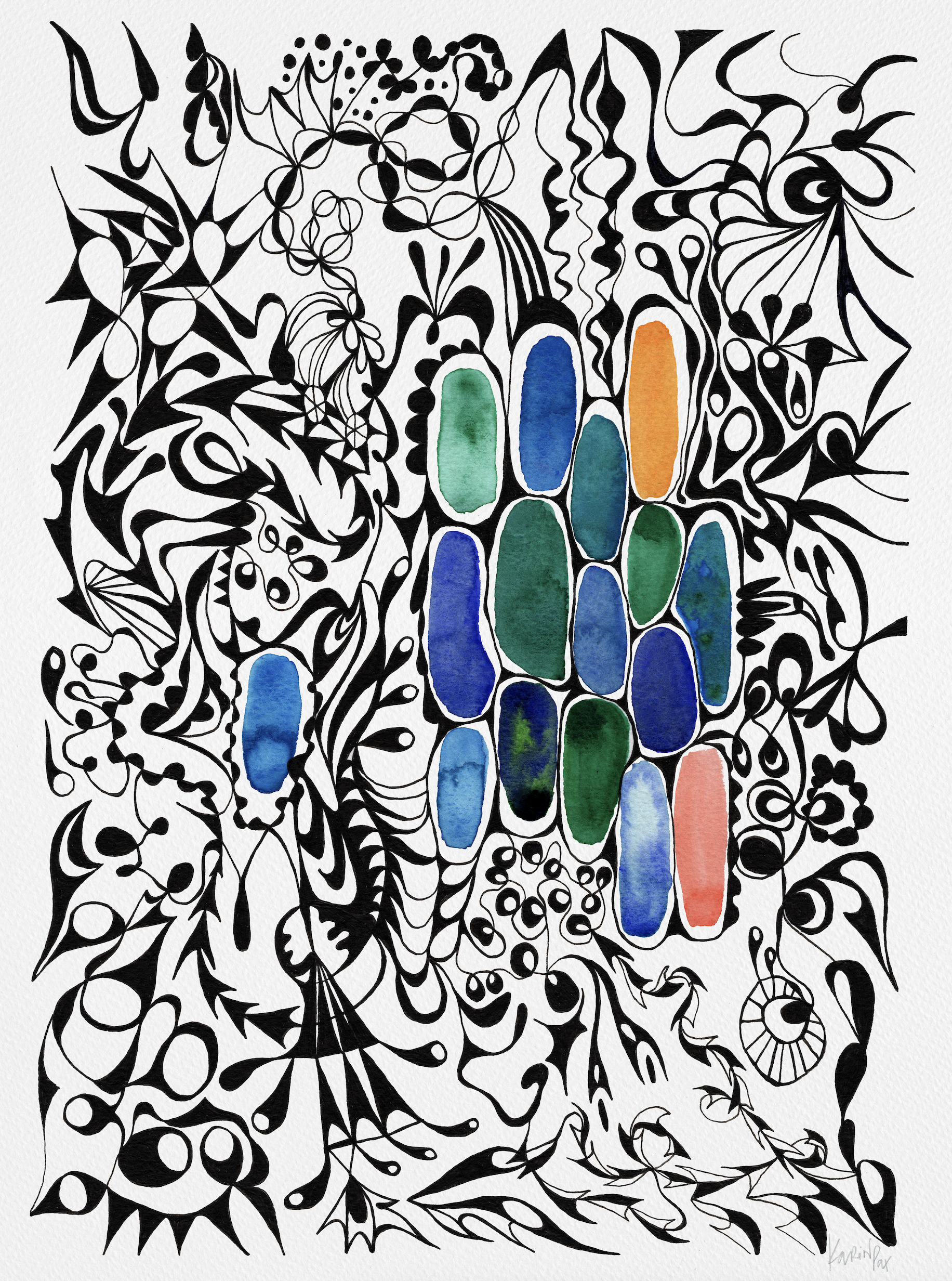
Threshold That Moves by Karina Da Paixao Teixeira
After experiencing recent surprising fearful moments, I have decided to spend some time investigating fear. While reflecting on a fear that I felt, I had insights and an urge to further understand types of fear, management of fear, the state of panicking, the accumulated tired nervous system, and each person's unique threshold for threat appraisal. Through my own experience I realised that we often let fear, or other affective reactions such as anxiety, harden into a trait, into something we believe describes our whole personality. Why can a single episode of fear feel so identity-threatening? For example, I thought that, in my identity, I have bravery. Haven't I changed countries, nationalities, professions and overcome challenges as if I could always go and get it? I am thinking that bravery cannot be a condition that a single fearful episode is allowed to cancel. And fear, if it means anything, cannot be reliable evidence of a permanent condition. It is data about the moment, and I don't see it as a verdict on the person. Maya Tamir and colleagues call it an entity theory of emotion, the belief that what we feel in a moment reveals something fixed and true about who we are, as opposed to an incremental theory, which treats a feeling as a passing state. Their research found that people who hold the fixed view get worse over time, not because they feel more, but because they read every feeling as a verdict.
Today, I am not discussing the fear that comes from trauma, but my observation is about the fear you are not programmed to feel. I used to love hiking and climbing at high altitude, other sports in the mountains, and travelling to places of difficult access. I was fine with situations where I didn't have much control, or with some kind of controlled risk. But, last month, for the first time, I was afraid of turbulence; I was also afraid of hurting myself while snowboarding; and I was afraid of the strong wind on top of a peak. And what happened is that when I felt fear in situations where I usually don't, I felt an identity-threatening state, which was confusing. I thought I did well by staying with my fear and emotional pain, but honestly, I put a lot of effort to face what was going on inside me. By looking back at my story, the data confirm that I am someone who is calm at altitude, and I have evidence of that, including some adventures in the Himalayas, and climbing other mountains. However, for the first time, I was, like, almost in panic mode doing something from which I usually feel only positive effects. So, I thought, wait, who is this? I don't feel like myself. This phenomenon was destabilising, and I am glad that I noticed, because the fear was compounding around the fear of this fear, which felt huge.
With my clients, I see the same with anxiety. It seems to be more like anxiety about the anxiety and how, as the state gets more chronic, it becomes part of you, if you let it be. Do you see why I am so interested in investigating my fear? This reflection is about my awareness, before reaching for "is this who I am now" and stopping before giving labels to the experiences. I decided to analyse the type of fear, because I knew that I was affected by the management of stress and the defect of my adaptation over time. To give context, it was my son's first experience of snowboarding, and he is an 11-year-old fearless kid who, like myself, has a curiosity impossible to stop. I am a single mother and our adventures are full of happiness, but challenges too. It is like I am having the best time but also constantly evaluating the dangers of my son's natural freedom and courageous behaviour. Not to my surprise, after a few hours, like many other children learning something, my son was on the highest part of the mountain, jumping and doing the perfect technique of snowboarding and having the best time ever, without any worries or concerns.
Reflecting on the arousal of fears in situations and conditions where I usually feel the most comfortable and at peace brings me to the realisation that we often make the mistake of believing that what we feel is about who we are. Our emotions and feelings not only affect our behaviour but also how we think about ourselves. This is a very important consideration because we naturally think we're our feelings, and we are not. To reflect further, I want to use McEwen and Stellar's foundational work regarding allostatic load. Allostatic load is the accumulated physiological cost of managing stress over time, and each person has their own unique threshold for threat appraisal, a threshold that is not fixed. When I was exhausted and hypervigilant as a mother, for example, I lowered my threshold for threat appraisal. The nervous system doesn't need an identity crisis to explain elevated reactivity; it just needs to be tired.
I notice the same shifting threshold in many of my clients and friends around this stage of life. More fear. Survival mode switched on for less reason than it used to need. Perimenopause is its own allostatic transition, not a personality change. Estrogen doesn't decline evenly. It fluctuates, and that fluctuation disrupts the very system meant to calm the alarm back down after a stressor. Researchers have found that women in this transition don't habituate to repeated stress the way we'd expect. The body keeps responding to the same test as though it were the first time. That is not a flaw in these women. It is the same thing that happened to me on the mountain, at a different scale.
So, in moments of intense feelings and emotions, mindfulness of this threshold of threat seems fundamental to bring us back to reality, and then we act appropriately and may feel "better" and think without distortions.
McEwen describes a version of allostatic load where the system fails to do the thing it is supposed to do with repetition: recognise that a stressor has been survived before, and stand down accordingly. An accumulated tired nervous system doesn't only sound the alarm too often; it also stops updating. It keeps responding to every wind as though the mountain were new. In his later work, McEwen makes a related point: the same stress mediators that protect us in an acute moment become damaging only through repetition, not because they are flawed, but because no system is built to sound an alarm indefinitely. That is the defect, and it does not reflect my character or personality: a defect in the adaptation itself, in the system's capacity to revise its own threat appraisal over time when it has not been given enough time, or enough rest, to do so. That's why the level of stress, mindfulness and management of stressors are essential for functioning and optimal health.
I think I am reflecting on a kind of fear that doesn't need protective distance because it isn't dangerous to look at directly. Fear of the force of nature, the wind, when you are vulnerable on an airplane. Fear when you are on top of the peak and the wind can easily throw you away. I am talking about a fear that probably carries no audience to perform for, probably because, although no one was observing me, my body and mind were extremely connected to my son, who was most of the time nowhere to be seen, happily doing his crazy and perfect moves and jumps. Perhaps, by analysing this type of fear, we can get better at investigating and confronting the fears that create a pathological presentation, leading to panic attacks or disruptive behaviours.
In this reflection I think about homeostasis: the body seeks a fixed point and returns to it, a thermostat holding a room at the same temperature no matter what happens outside. According to this model, any deviation is an error. A threshold that moves is a threshold that failed. On the other hand, allostasis is a different claim. Sterling and Eyer named it stability through change. Evidence shows that the body was never built to hold still. It anticipates. It adjusts the setpoint itself, before the demand even arrives, because adjusting is what keeps a living system alive in a world that doesn't hold still either. Allostasis makes more sense to me. It means the moving threshold I felt on that mountain was not a malfunction. It was the system doing exactly what an allostatic system does, responding to a demand, in this case exhaustion, by changing where the line is drawn. The same capacity that lowered my threshold when I was tired is the capacity that can raise it again when I am rested. A thermostat that breaks stays broken. A system built on allostasis, one that adapts down, can adapt back.
That is the part I think we skip past too quickly when we talk about fear as a flaw. A moving threshold is not proof of something wrong with me. It is proof I belong to the kind of system that can change, and that is the same system that will let me recover.
With curiosity and care for your story,
Karina
If you're curious…
Alebna, P., & Maleki, N. (2021). Allostatic load in perimenopausal women with migraine. Frontiers in Neurology, 12, 649423.
Gordon, J. L., Peltier, A., Grummisch, J. A., & Sykes Tottenham, L. (2019). Estradiol fluctuation, sensitivity to stress, and depressive symptoms in the menopause transition: A pilot study. Frontiers in Psychology, 10, 1319.
McEwen, B. S. (1998). Protective and damaging effects of stress mediators. New England Journal of Medicine, 338(3), 171–179.
McEwen, B. S., & Stellar, E. (1993). Stress and the individual: Mechanisms leading to disease. Archives of Internal Medicine, 153(18), 2093–2101.
Sterling, P., & Eyer, J. (1988). Allostasis: A new paradigm to explain arousal pathology. In S. Fisher & J. Reason (Eds.), Handbook of life stress, cognition and health (pp. 629–649). Wiley.
Tamir, M., John, O. P., Srivastava, S., & Gross, J. J. (2007). Implicit theories of emotion: Affective and social outcomes across a major life transition. Journal of Personality and Social Psychology, 92(4), 731–744.