
Emotional Discomfort and Self-Actualisation
What Wandering Looks Like from the Inside
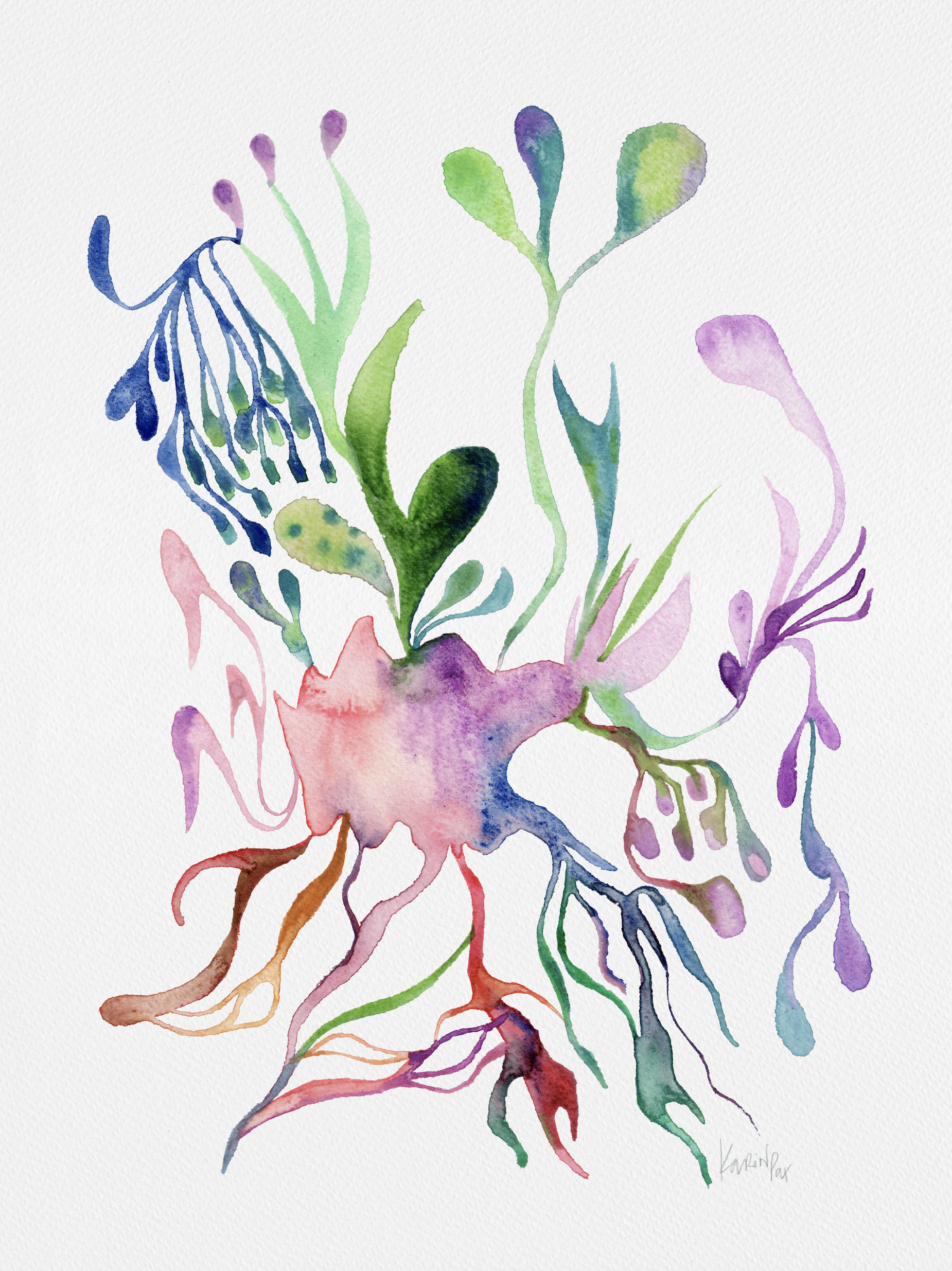
Emotional Discomfort by Karina Da Paixao Teixeira
Moments that arrive quietly and stay loud get my attention.
I was at a party recently, half-present the way you sometimes are in a room full of noise, when a friend described me to someone. She listed some parts of me, what I had done and become: architect, then nurse, now psychotherapist. And then the interpretation: “like she doesn’t know what she wants.” She wasn’t being cruel. I know that. But the words landed somewhere, and I didn’t reach to correct her. I went still, inside me.
Something in me was more curious than defensive. And curiosity, my expertise, my strength, and maybe from others’ view, my weakness. Wait, I truly don’t believe it is my weakness. But I understand how my curiosity about learning different things can be seen as a loss of time or focus in life. Specially for people who see life as a linear structure. Anyway, back to the party, I chose not to answer even though I had plenty to say.
Curiosity, I have learned, is almost always the more honest response.
I sat with the discomfort on the drive home. I sat with it the next day. And what it gave me, slowly, was not a rebuttal. It was a question worth taking seriously: what does a life actually look like from the outside, when the person living it has spent years following something real rather than something legible?
This reflection is my attempt to answer that. I am not answering for her. This is not the first person who misread my choices. I am writing this to validate anyone whose path looked, from a certain angle, like confusion, and felt, from the inside, like the bravest thing they had ever done.
We live inside a story about what a life is supposed to look like.
A story about success that most of us never chose to believe, but absorbed anyway. It goes something like this: you find your thing, you commit to it, you build, you accumulate, you arrive. The line moves upward and to the right. Deviation from it reads as failure, or at best, as a detour you will eventually explain away.
This story is so dominant it has almost no edges. It shapes how we write CVs, how we introduce ourselves at parties, how we quietly measure our lives against other people’s lives at 2 am when we can’t sleep. It is the water most of us swim in without noticing it is water at all.
And society as we experienced, it is particularly unkind to certain kind of person. Unless you make tons of money, and being out of the box has been justified then. I see unkindness toward the one who cannot stay in something that has stopped being true. The one who follows a force they cannot always name. The one who reinvents not because they are lost, but because they are, in some stubborn and costly way, trying to find their truth, instead of living the conditioned. Bravery is worth, but I see the cost of being misread for many. It is so very interesting. Projections, they are always hurting unconsciously.
I am the out of the box person. My north is my curiosity of my own self. So, I have been that person. I could say, to agree with the norms of society, that I carried a shame about it, but I never really felt any shame regarding my path. I never lacked the discipline or the clarity to stay forever in the same trajectory, I am just too connected to the urge inside me, and I listen to it, with confidence. I remember being very young and having this confidence. But from the eyes of others, I know that I could be seeing as too much and not enough at the same time.
What I know now, and what took years of living and studying and sitting with difficult things to understand, is that the shame was never mine to carry. It belongs to the story. Which, my apologies for the tangent, makes me think about narrative therapy. The insult of others regarding the twists of my path, belong to the “linear and unrealistic perfect society story”. This story was and is just too small for the life I am actually living.
Carl Rogers, whose work is the heart of person-centred therapy, believed that every human organism carries within it an innate drive toward growth. He called it the actualising tendency. As he describes, it is not a philosophy, neither an aspiration, but a biological fact: something in us is always oriented toward becoming more fully itself, the way a plant turns toward light not because it decides to, but because that it is nature.
He also observed something quietly devastating about what happens to that drive in childhood. When the people we depend on for survival offer love conditionally, when approval comes only for the version of us that is convenient, quiet, successful in the expected ways, we learn to override the organism’s knowing. We learn to want what we are supposed to want. To become who we are supposed to become. And we do it so thoroughly, so early, that most of us forget we made the trade.
Rogers called what gets buried the organismic valuing process. It is the body’s own system for evaluating experience, what feels alive versus what feels deadening, what expands versus what contracts. It operates below language, below strategy, below that part of us that knows how to perform competence at a party.
And when conditions of worth, those early messages about who we must be to deserve love, are heavy enough, that inner compass gets harder and harder to hear.
The people who wander are not always lost. I never felt lost. Sometimes they are the ones who never stopped listening to that compass, even when it led them somewhere that made no sense to anyone watching from the outside. Even when it cost them the comfort of a tidy answer to the question: so, what do you do?
Following the organism’s knowing is not reckless. It is not the absence of direction. It is a different kind of direction entirely, one that cannot always be explained in advance, only recognised in retrospect. When you look back and see that every strange turn was actually toward something, that through-line was always there, just not the kind that fits on a traditional CV.
I think Carl Jung would have had little patience for the idea that a life must move in one direction to mean something. His entire framework was built on a different premise: that the psyche is far larger than the ego knows, and that growth, real growth, is not linear accumulation but the slow, sometimes painful work of becoming whole.
Jung called this process individuation. It is not self-improvement. It is not about optimization. It is something closer to the retrieval of everything you actually are, including the parts that were inconvenient, suppressed, or simply never given conditions in which to grow.
Central to this is what Jung called the shadow. Everything the ego learns to disown gets pushed underground, not destroyed, just invisible. And the shadow is not only what is dark or destructive in us. It also contains what Jung called the gold: the unlived potential, the suppressed gifts, the needs and desires and capacities that had no safe place to exist in the environment we were given. The creative child told to be practical. The sensitive person told to be toughened up. The one with many hungers told to pick one and stay there.
The wanderer, seen through this lens, is often someone whose shadow keeps insisting. Whose gold keeps pulling. Each reinvention is not a failure of commitment. It is the psyche’s refusal to leave parts of itself permanently underground.
Jung also observed that what we cannot own in ourselves we tend to project outward. We see it in other people instead, usually with a disproportionate emotional charge that tells us something important is being touched. The person who calls someone else lost or crazy may be in contact with something unresolved in themselves, their own unlived life pressing from below, their own uncrossed thresholds making the sight of someone who crosses them quietly unbearable.
This is not a judgement. I see it as a structure. Jung saw it everywhere, in individuals, in relationships, in cultures. And understanding it changes the quality of the sting. When someone misreads your path, when they flatten your reinventions into indecision, the pain is real. But underneath the pain, there is often something clarifying: they are reading you through the story they have had to tell themselves. They cannot yet see what you are doing because seeing it would cost them something.
You do not owe anyone a life they can easily summarise. But you owe yourself the honesty of knowing what you are actually doing, and why.
Another question that is harder to hold, but important not to avoid: how much of it was ever really chosen?
Robert Sapolsky, a neuroendocrinologist and primatologist at Stanford, spent decades studying behaviour across species before arriving at a conclusion that is both unsettling and, in a strange way, deeply kind. In his book Determined, he argues that every behaviour, every decision, every turn a life takes, is the outcome of a seamless chain of causes stretching back further than any individual life. The neurons firing in the second before you act. The hormones circulating that morning. The experiences that shaped your nervous system in childhood. The fetal environment. The genes. The culture your ancestors built. The evolutionary pressures that made the human brain what it is over millions of years.
I understand that he is not saying nothing matters. He is saying that who you are, and who you have become, and every choice you have made along the way, is the output of conditions you did not choose, interacting with an organism you did not design, inside a world you were born into rather than selected.
I know, this could sound bleak. It doesn’t have to be.
Because what it means, taken seriously, is that the child who could not become herself in the environment she was given was not failing. She was surviving. The adult who spent years following a pull she couldn’t name, taking paths that made no economic sense, reinventing in ways that confused the people around her, was not lacking discipline or clarity. She was doing something extraordinarily difficult inside a system not built to support it, with a nervous system shaped by everything that came before, trying, against considerable odds, to find her way back to something true.
Sapolsky’s determinism, at its most humane, is an argument for compassion. For your self first. For the understanding that the shame you carried about not being linear was never evidence of a flaw. It was evidence of conditions. Conditions of childhood that made certain paths unsafe. Conditions of culture that made certain lives illegible. Conditions of biology that made the organism keep reaching for what it needed even when the mind had learned to apologise for the reaching.
And for others too. The friend who could not read your path generously was also shaped by conditions she did not choose. Her story about what a life should look like was given to her before she had the tools to question it. That doesn’t make the words harmless. But it makes them less personal. She was not seeing you. She was seeing you through everything that had shaped her capacity to see.
If you are reading this and you recognise yourself in any of it, the reinventions, the paths that didn’t make sense to anyone watching, the quiet cost of following something true in a world that rewards something legible, I want you to know that I am not writing from a place of arrival.
I am writing from the middle of it.
I am a nurse and a counsellor and a psychotherapist and I may also call myself an artist. I am someone who has built and rebuilt and is still building. My path has not been economically optimal. It has not been easy to explain at parties. It has asked things of me that more conventional choices would not have asked.
But I have also learned something that I did not know how to know earlier, and it is this: the life that cannot be summarised in ten seconds is not a lesser life. It is often a more honest one. The person who keeps moving toward what is real, even when what is real keeps changing shape, is not confused. They are doing the slow, costly, necessary work of becoming who they actually are.
Rogers called it the actualising tendency. Jung called it individuation. Sapolsky would say it was always going to unfold this way, given everything that shaped you. I call it the long way round. And I think, for some of us, it is the only way that was ever really available.
There is a particular kind of loneliness in being misread by people who love you. In standing in a room full of noise and hearing your life described as a problem to be solved. I won’t pretend it doesn’t land. It does. But I have also come to understand that the people who struggle most to read a non-linear life are often the ones most privately haunted by their own unlived paths. The wanderer threatens something. Not because she is lost. But because she isn’t.
So, this is for the ones who wander. Who have been called crazy or unfocused or too much or not enough. Who have sat in cars after parties holding something that felt like sadness, but was actually closer to clarity. Who have chosen, more than once, the path that cost more and explained less and brought them, slowly, undeniably, closer to themselves.
You are not behind. You are not failing to arrive somewhere you were supposed to be by now.
You are perhaps, simply taking the long way round. And the long way round, it turns out, was always the most direct route to who you actually are.
With curiosity and care for your story, Karina
If you’re curious…
Rogers, C. R. (1961). On Becoming a Person: A Therapist’s View of Psychotherapy. Houghton Mifflin.
Jung, C. G. (1954). The Development of Personality. Collected Works, Vol. 17. Princeton University Press.
Jung, C. G. (1964). Man and His Symbols. Doubleday.
Sapolsky, R. M. (2023). Determined: A Science of Life Without Free Will. Penguin Press.
Stevens, A. (1994). Jung: A Very Short Introduction. Oxford University Press.