
A Threshold That Moves
On fear, identity, and the difference between a feeling and a verdict
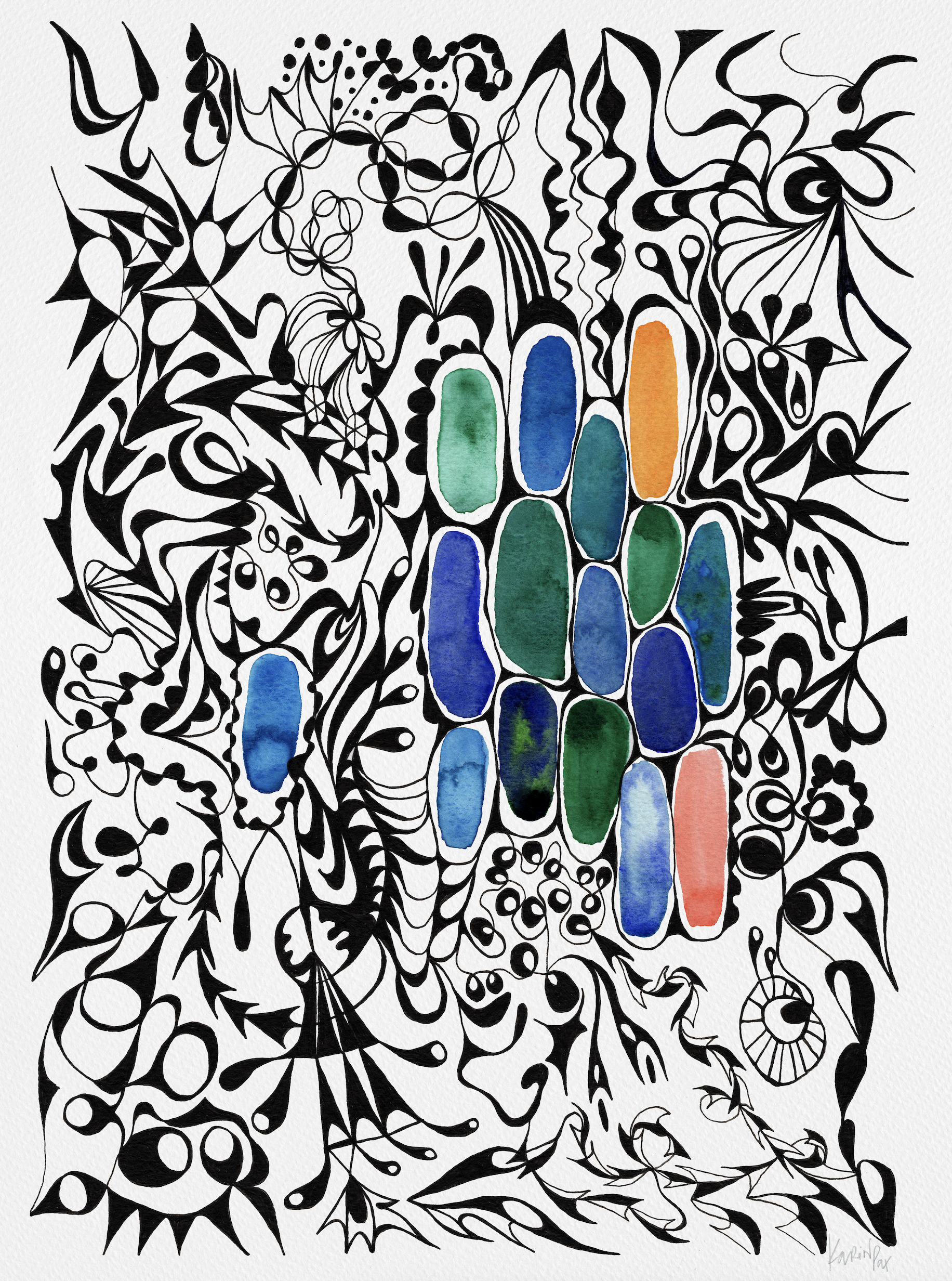
Threshold That Moves by Karina Da Paixao Teixeira
After experiencing recent surprising fearful moments, I have decided to spend some time investigating fear. While reflecting on a fear that I felt, I had insights and an urge to further understand types of fear, management of fear, the state of panicking, the accumulated tired nervous system, and each person's unique threshold for threat appraisal. Through my own experience I realised that we often let fear, or other affective reactions such as anxiety, harden into a trait, into something we believe describes our whole personality. Why can a single episode of fear feel so identity-threatening? For example, I thought that, in my identity, I have bravery. Haven't I changed countries, nationalities, professions and overcome challenges as if I could always go and get it? I am thinking that bravery cannot be a condition that a single fearful episode is allowed to cancel. And fear, if it means anything, cannot be reliable evidence of a permanent condition. It is data about the moment, and I don't see it as a verdict on the person. Maya Tamir and colleagues call it an entity theory of emotion, the belief that what we feel in a moment reveals something fixed and true about who we are, as opposed to an incremental theory, which treats a feeling as a passing state. Their research found that people who hold the fixed view get worse over time, not because they feel more, but because they read every feeling as a verdict.
Today, I am not discussing the fear that comes from trauma, but my observation is about the fear you are not programmed to feel. I used to love hiking and climbing at high altitude, other sports in the mountains, and travelling to places of difficult access. I was fine with situations where I didn't have much control, or with some kind of controlled risk. But, last month, for the first time, I was afraid of turbulence; I was also afraid of hurting myself while snowboarding; and I was afraid of the strong wind on top of a peak. And what happened is that when I felt fear in situations where I usually don't, I felt an identity-threatening state, which was confusing. I thought I did well by staying with my fear and emotional pain, but honestly, I put a lot of effort to face what was going on inside me. By looking back at my story, the data confirm that I am someone who is calm at altitude, and I have evidence of that, including some adventures in the Himalayas, and climbing other mountains. However, for the first time, I was, like, almost in panic mode doing something from which I usually feel only positive effects. So, I thought, wait, who is this? I don't feel like myself. This phenomenon was destabilising, and I am glad that I noticed, because the fear was compounding around the fear of this fear, which felt huge.
With my clients, I see the same with anxiety. It seems to be more like anxiety about the anxiety and how, as the state gets more chronic, it becomes part of you, if you let it be. Do you see why I am so interested in investigating my fear? This reflection is about my awareness, before reaching for "is this who I am now" and stopping before giving labels to the experiences. I decided to analyse the type of fear, because I knew that I was affected by the management of stress and the defect of my adaptation over time. To give context, it was my son's first experience of snowboarding, and he is an 11-year-old fearless kid who, like myself, has a curiosity impossible to stop. I am a single mother and our adventures are full of happiness, but challenges too. It is like I am having the best time but also constantly evaluating the dangers of my son's natural freedom and courageous behaviour. Not to my surprise, after a few hours, like many other children learning something, my son was on the highest part of the mountain, jumping and doing the perfect technique of snowboarding and having the best time ever, without any worries or concerns.
Reflecting on the arousal of fears in situations and conditions where I usually feel the most comfortable and at peace brings me to the realisation that we often make the mistake of believing that what we feel is about who we are. Our emotions and feelings not only affect our behaviour but also how we think about ourselves. This is a very important consideration because we naturally think we're our feelings, and we are not. To reflect further, I want to use McEwen and Stellar's foundational work regarding allostatic load. Allostatic load is the accumulated physiological cost of managing stress over time, and each person has their own unique threshold for threat appraisal, a threshold that is not fixed. When I was exhausted and hypervigilant as a mother, for example, I lowered my threshold for threat appraisal. The nervous system doesn't need an identity crisis to explain elevated reactivity; it just needs to be tired.
I notice the same shifting threshold in many of my clients and friends around this stage of life. More fear. Survival mode switched on for less reason than it used to need. Perimenopause is its own allostatic transition, not a personality change. Estrogen doesn't decline evenly. It fluctuates, and that fluctuation disrupts the very system meant to calm the alarm back down after a stressor. Researchers have found that women in this transition don't habituate to repeated stress the way we'd expect. The body keeps responding to the same test as though it were the first time. That is not a flaw in these women. It is the same thing that happened to me on the mountain, at a different scale.
So, in moments of intense feelings and emotions, mindfulness of this threshold of threat seems fundamental to bring us back to reality, and then we act appropriately and may feel "better" and think without distortions.
McEwen describes a version of allostatic load where the system fails to do the thing it is supposed to do with repetition: recognise that a stressor has been survived before, and stand down accordingly. An accumulated tired nervous system doesn't only sound the alarm too often; it also stops updating. It keeps responding to every wind as though the mountain were new. In his later work, McEwen makes a related point: the same stress mediators that protect us in an acute moment become damaging only through repetition, not because they are flawed, but because no system is built to sound an alarm indefinitely. That is the defect, and it does not reflect my character or personality: a defect in the adaptation itself, in the system's capacity to revise its own threat appraisal over time when it has not been given enough time, or enough rest, to do so. That's why the level of stress, mindfulness and management of stressors are essential for functioning and optimal health.
I think I am reflecting on a kind of fear that doesn't need protective distance because it isn't dangerous to look at directly. Fear of the force of nature, the wind, when you are vulnerable on an airplane. Fear when you are on top of the peak and the wind can easily throw you away. I am talking about a fear that probably carries no audience to perform for, probably because, although no one was observing me, my body and mind were extremely connected to my son, who was most of the time nowhere to be seen, happily doing his crazy and perfect moves and jumps. Perhaps, by analysing this type of fear, we can get better at investigating and confronting the fears that create a pathological presentation, leading to panic attacks or disruptive behaviours.
In this reflection I think about homeostasis: the body seeks a fixed point and returns to it, a thermostat holding a room at the same temperature no matter what happens outside. According to this model, any deviation is an error. A threshold that moves is a threshold that failed. On the other hand, allostasis is a different claim. Sterling and Eyer named it stability through change. Evidence shows that the body was never built to hold still. It anticipates. It adjusts the setpoint itself, before the demand even arrives, because adjusting is what keeps a living system alive in a world that doesn't hold still either. Allostasis makes more sense to me. It means the moving threshold I felt on that mountain was not a malfunction. It was the system doing exactly what an allostatic system does, responding to a demand, in this case exhaustion, by changing where the line is drawn. The same capacity that lowered my threshold when I was tired is the capacity that can raise it again when I am rested. A thermostat that breaks stays broken. A system built on allostasis, one that adapts down, can adapt back.
That is the part I think we skip past too quickly when we talk about fear as a flaw. A moving threshold is not proof of something wrong with me. It is proof I belong to the kind of system that can change, and that is the same system that will let me recover.
With curiosity and care for your story,
Karina
If you're curious…
Alebna, P., & Maleki, N. (2021). Allostatic load in perimenopausal women with migraine. Frontiers in Neurology, 12, 649423.
Gordon, J. L., Peltier, A., Grummisch, J. A., & Sykes Tottenham, L. (2019). Estradiol fluctuation, sensitivity to stress, and depressive symptoms in the menopause transition: A pilot study. Frontiers in Psychology, 10, 1319.
McEwen, B. S. (1998). Protective and damaging effects of stress mediators. New England Journal of Medicine, 338(3), 171–179.
McEwen, B. S., & Stellar, E. (1993). Stress and the individual: Mechanisms leading to disease. Archives of Internal Medicine, 153(18), 2093–2101.
Sterling, P., & Eyer, J. (1988). Allostasis: A new paradigm to explain arousal pathology. In S. Fisher & J. Reason (Eds.), Handbook of life stress, cognition and health (pp. 629–649). Wiley.
Tamir, M., John, O. P., Srivastava, S., & Gross, J. J. (2007). Implicit theories of emotion: Affective and social outcomes across a major life transition. Journal of Personality and Social Psychology, 92(4), 731–744.
Emotional Discomfort and Self-Actualisation
What Wandering Looks Like from the Inside
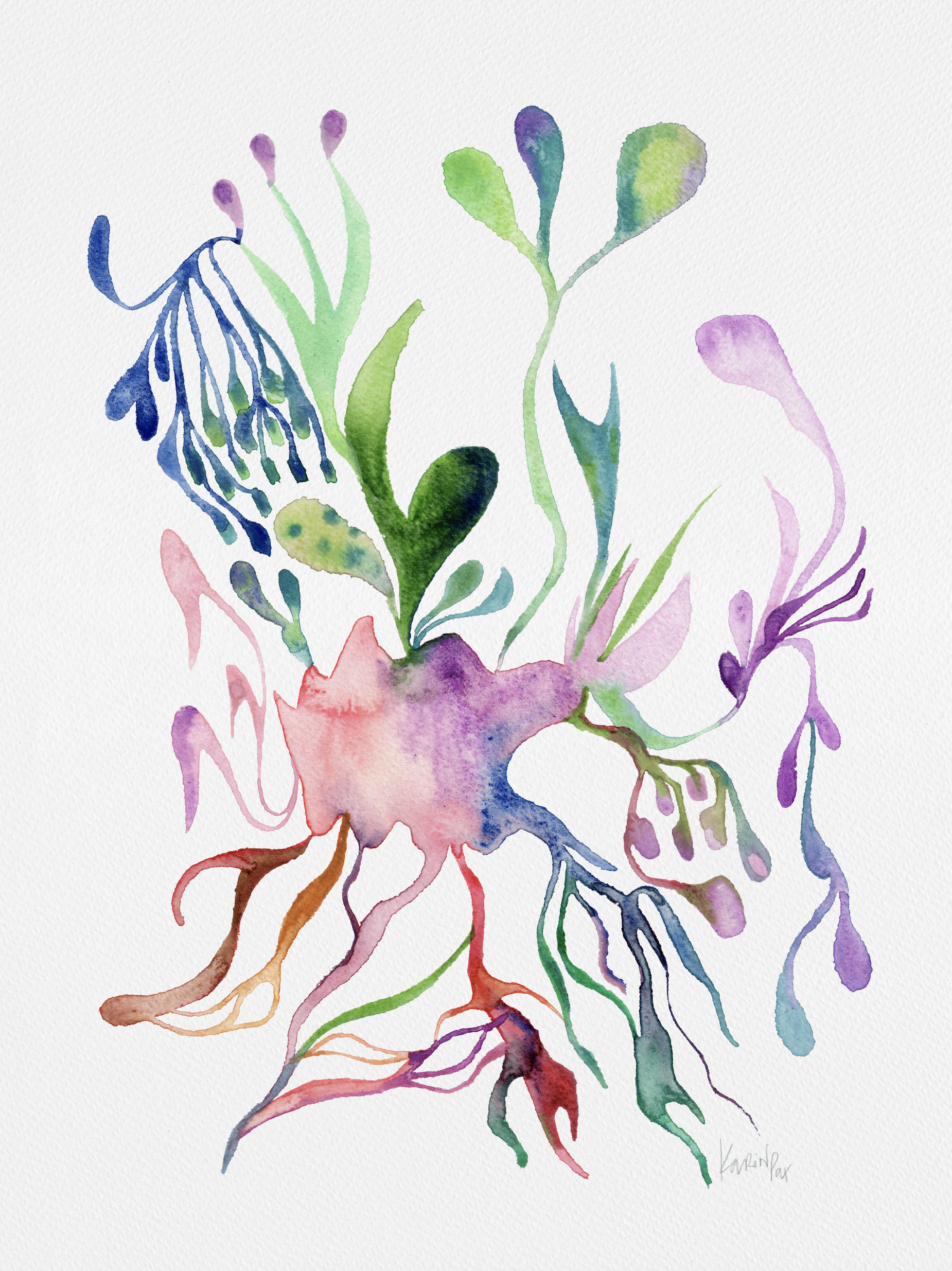
Emotional Discomfort by Karina Da Paixao Teixeira
Moments that arrive quietly and stay loud get my attention.
I was at a party recently, half-present the way you sometimes are in a room full of noise, when a friend described me to someone. She listed some parts of me, what I had done and become: architect, then nurse, now psychotherapist. And then the interpretation: “like she doesn’t know what she wants.” She wasn’t being cruel. I know that. But the words landed somewhere, and I didn’t reach to correct her. I went still, inside me.
Something in me was more curious than defensive. And curiosity, my expertise, my strength, and maybe from others’ view, my weakness. Wait, I truly don’t believe it is my weakness. But I understand how my curiosity about learning different things can be seen as a loss of time or focus in life. Specially for people who see life as a linear structure. Anyway, back to the party, I chose not to answer even though I had plenty to say.
Curiosity, I have learned, is almost always the more honest response.
I sat with the discomfort on the drive home. I sat with it the next day. And what it gave me, slowly, was not a rebuttal. It was a question worth taking seriously: what does a life actually look like from the outside, when the person living it has spent years following something real rather than something legible?
This reflection is my attempt to answer that. I am not answering for her. This is not the first person who misread my choices. I am writing this to validate anyone whose path looked, from a certain angle, like confusion, and felt, from the inside, like the bravest thing they had ever done.
We live inside a story about what a life is supposed to look like.
A story about success that most of us never chose to believe, but absorbed anyway. It goes something like this: you find your thing, you commit to it, you build, you accumulate, you arrive. The line moves upward and to the right. Deviation from it reads as failure, or at best, as a detour you will eventually explain away.
This story is so dominant it has almost no edges. It shapes how we write CVs, how we introduce ourselves at parties, how we quietly measure our lives against other people’s lives at 2 am when we can’t sleep. It is the water most of us swim in without noticing it is water at all.
And society as we experienced, it is particularly unkind to certain kind of person. Unless you make tons of money, and being out of the box has been justified then. I see unkindness toward the one who cannot stay in something that has stopped being true. The one who follows a force they cannot always name. The one who reinvents not because they are lost, but because they are, in some stubborn and costly way, trying to find their truth, instead of living the conditioned. Bravery is worth, but I see the cost of being misread for many. It is so very interesting. Projections, they are always hurting unconsciously.
I am the out of the box person. My north is my curiosity of my own self. So, I have been that person. I could say, to agree with the norms of society, that I carried a shame about it, but I never really felt any shame regarding my path. I never lacked the discipline or the clarity to stay forever in the same trajectory, I am just too connected to the urge inside me, and I listen to it, with confidence. I remember being very young and having this confidence. But from the eyes of others, I know that I could be seeing as too much and not enough at the same time.
What I know now, and what took years of living and studying and sitting with difficult things to understand, is that the shame was never mine to carry. It belongs to the story. Which, my apologies for the tangent, makes me think about narrative therapy. The insult of others regarding the twists of my path, belong to the “linear and unrealistic perfect society story”. This story was and is just too small for the life I am actually living.
Carl Rogers, whose work is the heart of person-centred therapy, believed that every human organism carries within it an innate drive toward growth. He called it the actualising tendency. As he describes, it is not a philosophy, neither an aspiration, but a biological fact: something in us is always oriented toward becoming more fully itself, the way a plant turns toward light not because it decides to, but because that it is nature.
He also observed something quietly devastating about what happens to that drive in childhood. When the people we depend on for survival offer love conditionally, when approval comes only for the version of us that is convenient, quiet, successful in the expected ways, we learn to override the organism’s knowing. We learn to want what we are supposed to want. To become who we are supposed to become. And we do it so thoroughly, so early, that most of us forget we made the trade.
Rogers called what gets buried the organismic valuing process. It is the body’s own system for evaluating experience, what feels alive versus what feels deadening, what expands versus what contracts. It operates below language, below strategy, below that part of us that knows how to perform competence at a party.
And when conditions of worth, those early messages about who we must be to deserve love, are heavy enough, that inner compass gets harder and harder to hear.
The people who wander are not always lost. I never felt lost. Sometimes they are the ones who never stopped listening to that compass, even when it led them somewhere that made no sense to anyone watching from the outside. Even when it cost them the comfort of a tidy answer to the question: so, what do you do?
Following the organism’s knowing is not reckless. It is not the absence of direction. It is a different kind of direction entirely, one that cannot always be explained in advance, only recognised in retrospect. When you look back and see that every strange turn was actually toward something, that through-line was always there, just not the kind that fits on a traditional CV.
I think Carl Jung would have had little patience for the idea that a life must move in one direction to mean something. His entire framework was built on a different premise: that the psyche is far larger than the ego knows, and that growth, real growth, is not linear accumulation but the slow, sometimes painful work of becoming whole.
Jung called this process individuation. It is not self-improvement. It is not about optimization. It is something closer to the retrieval of everything you actually are, including the parts that were inconvenient, suppressed, or simply never given conditions in which to grow.
Central to this is what Jung called the shadow. Everything the ego learns to disown gets pushed underground, not destroyed, just invisible. And the shadow is not only what is dark or destructive in us. It also contains what Jung called the gold: the unlived potential, the suppressed gifts, the needs and desires and capacities that had no safe place to exist in the environment we were given. The creative child told to be practical. The sensitive person told to be toughened up. The one with many hungers told to pick one and stay there.
The wanderer, seen through this lens, is often someone whose shadow keeps insisting. Whose gold keeps pulling. Each reinvention is not a failure of commitment. It is the psyche’s refusal to leave parts of itself permanently underground.
Jung also observed that what we cannot own in ourselves we tend to project outward. We see it in other people instead, usually with a disproportionate emotional charge that tells us something important is being touched. The person who calls someone else lost or crazy may be in contact with something unresolved in themselves, their own unlived life pressing from below, their own uncrossed thresholds making the sight of someone who crosses them quietly unbearable.
This is not a judgement. I see it as a structure. Jung saw it everywhere, in individuals, in relationships, in cultures. And understanding it changes the quality of the sting. When someone misreads your path, when they flatten your reinventions into indecision, the pain is real. But underneath the pain, there is often something clarifying: they are reading you through the story they have had to tell themselves. They cannot yet see what you are doing because seeing it would cost them something.
You do not owe anyone a life they can easily summarise. But you owe yourself the honesty of knowing what you are actually doing, and why.
Another question that is harder to hold, but important not to avoid: how much of it was ever really chosen?
Robert Sapolsky, a neuroendocrinologist and primatologist at Stanford, spent decades studying behaviour across species before arriving at a conclusion that is both unsettling and, in a strange way, deeply kind. In his book Determined, he argues that every behaviour, every decision, every turn a life takes, is the outcome of a seamless chain of causes stretching back further than any individual life. The neurons firing in the second before you act. The hormones circulating that morning. The experiences that shaped your nervous system in childhood. The fetal environment. The genes. The culture your ancestors built. The evolutionary pressures that made the human brain what it is over millions of years.
I understand that he is not saying nothing matters. He is saying that who you are, and who you have become, and every choice you have made along the way, is the output of conditions you did not choose, interacting with an organism you did not design, inside a world you were born into rather than selected.
I know, this could sound bleak. It doesn’t have to be.
Because what it means, taken seriously, is that the child who could not become herself in the environment she was given was not failing. She was surviving. The adult who spent years following a pull she couldn’t name, taking paths that made no economic sense, reinventing in ways that confused the people around her, was not lacking discipline or clarity. She was doing something extraordinarily difficult inside a system not built to support it, with a nervous system shaped by everything that came before, trying, against considerable odds, to find her way back to something true.
Sapolsky’s determinism, at its most humane, is an argument for compassion. For your self first. For the understanding that the shame you carried about not being linear was never evidence of a flaw. It was evidence of conditions. Conditions of childhood that made certain paths unsafe. Conditions of culture that made certain lives illegible. Conditions of biology that made the organism keep reaching for what it needed even when the mind had learned to apologise for the reaching.
And for others too. The friend who could not read your path generously was also shaped by conditions she did not choose. Her story about what a life should look like was given to her before she had the tools to question it. That doesn’t make the words harmless. But it makes them less personal. She was not seeing you. She was seeing you through everything that had shaped her capacity to see.
If you are reading this and you recognise yourself in any of it, the reinventions, the paths that didn’t make sense to anyone watching, the quiet cost of following something true in a world that rewards something legible, I want you to know that I am not writing from a place of arrival.
I am writing from the middle of it.
I am a nurse and a counsellor and a psychotherapist and I may also call myself an artist. I am someone who has built and rebuilt and is still building. My path has not been economically optimal. It has not been easy to explain at parties. It has asked things of me that more conventional choices would not have asked.
But I have also learned something that I did not know how to know earlier, and it is this: the life that cannot be summarised in ten seconds is not a lesser life. It is often a more honest one. The person who keeps moving toward what is real, even when what is real keeps changing shape, is not confused. They are doing the slow, costly, necessary work of becoming who they actually are.
Rogers called it the actualising tendency. Jung called it individuation. Sapolsky would say it was always going to unfold this way, given everything that shaped you. I call it the long way round. And I think, for some of us, it is the only way that was ever really available.
There is a particular kind of loneliness in being misread by people who love you. In standing in a room full of noise and hearing your life described as a problem to be solved. I won’t pretend it doesn’t land. It does. But I have also come to understand that the people who struggle most to read a non-linear life are often the ones most privately haunted by their own unlived paths. The wanderer threatens something. Not because she is lost. But because she isn’t.
So, this is for the ones who wander. Who have been called crazy or unfocused or too much or not enough. Who have sat in cars after parties holding something that felt like sadness, but was actually closer to clarity. Who have chosen, more than once, the path that cost more and explained less and brought them, slowly, undeniably, closer to themselves.
You are not behind. You are not failing to arrive somewhere you were supposed to be by now.
You are perhaps, simply taking the long way round. And the long way round, it turns out, was always the most direct route to who you actually are.
With curiosity and care for your story, Karina
If you’re curious…
Rogers, C. R. (1961). On Becoming a Person: A Therapist’s View of Psychotherapy. Houghton Mifflin.
Jung, C. G. (1954). The Development of Personality. Collected Works, Vol. 17. Princeton University Press.
Jung, C. G. (1964). Man and His Symbols. Doubleday.
Sapolsky, R. M. (2023). Determined: A Science of Life Without Free Will. Penguin Press.
Stevens, A. (1994). Jung: A Very Short Introduction. Oxford University Press.
When the Body Cannot Afford to Learn
On neuroception, developmental trauma, and the children we were
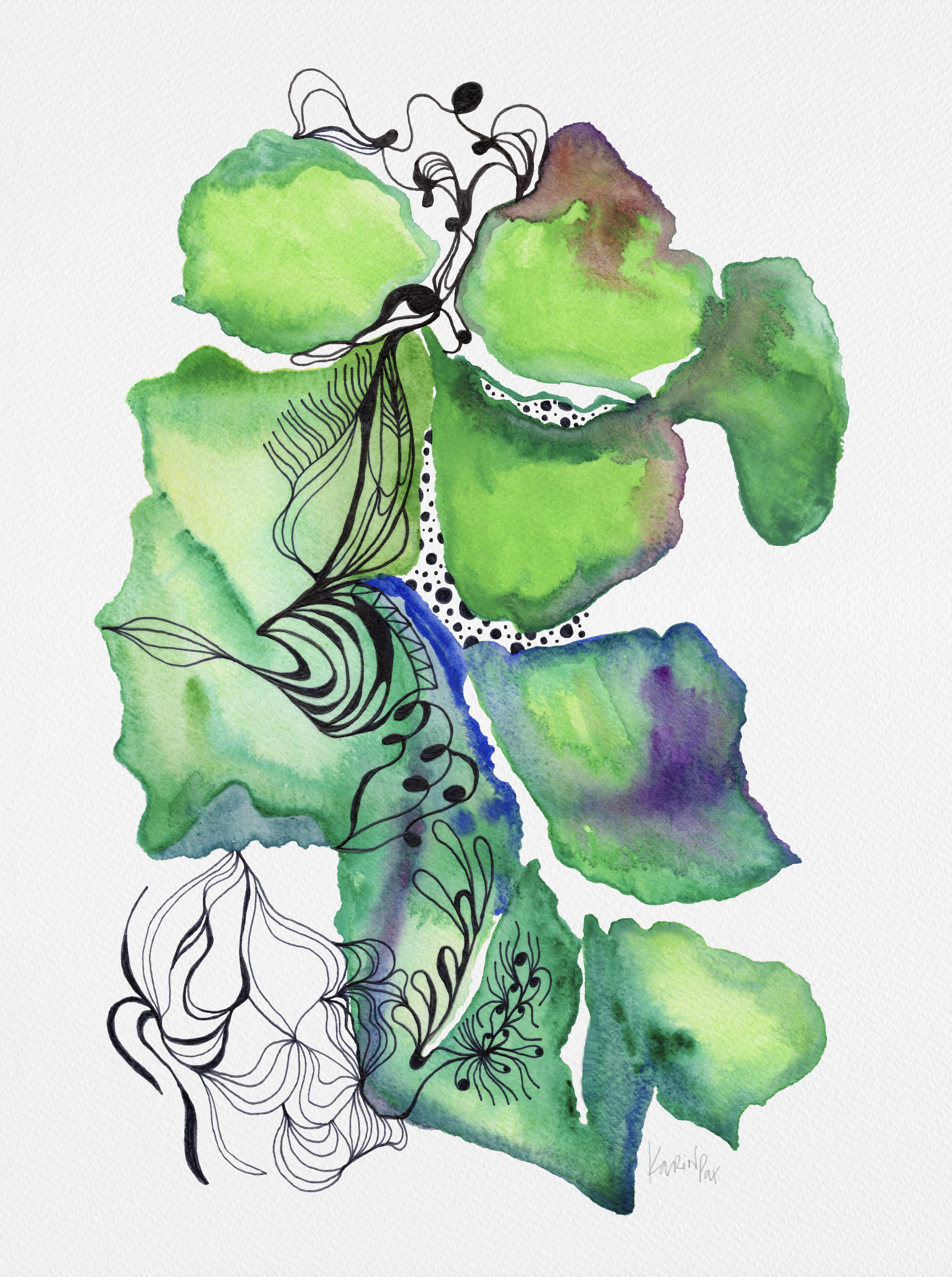
Unfinished by Karina Da Paixao Teixeira
From my experience inside the health system, and as my personal opinion, there is a question asked far too often, and it points in the wrong direction.
“What is wrong with this child?”
Every time I hear it, something in me quietly turns it over. But what happened to this child?
The two questions look similar from a distance. In practice, they lead somewhere entirely different.
One leads to a diagnosis. The other leads to a person.
Safety is not a feeling we choose to have. It cannot be just a breathing technique, or something a child can summon if they try hard enough. It is a physiological state, one that the nervous system either inhabits or does not, based on a continuous, largely unconscious scanning of the environment for cues of threat or connection.
Stephen Porges named this process neuroception. It happens beneath conscious awareness, faster than thought, reading the tone of a voice, the tension in a room, the predictability of a caregiver, the history written into the body by everything that came before. When neuroception detects safety, the ventral vagal system activates. Social engagement becomes possible. Curiosity opens. Learning becomes available.
When it detects threat, the system shifts. The body mobilises for survival. Everything that is not immediately necessary for that task, including attention, memory consolidation, the capacity to take in new information, gets subordinated to a more urgent priority.
We are not talking about dysfunction. We are talking about biology doing precisely what biology is designed to do. The nervous system is functional. It is doing the job of protecting body and mind.
The problem is that we have built schools, clinics, and systems of care that do not account for it.
I know this from the literature, and I know it from the children I sit with. But I also know it from somewhere more personal than either of those.
I was once a kid that could not concentrate or learn.
During the beginning of my high school years, my father was involved in a severe accident that left seventy percent of his body burnt. He spent nine months in hospital. My mother, managing the weight of that, was largely absent. I was twelve years old, and I was already navigating a fracturing sense of who I was and where I belonged. I sat in classrooms during that time. Teachers stood at the front of rooms and wrote things on boards. I have almost no memory of any of this time.
I was intelligent, and I was trying hard to learn. But my nervous system was fully occupied with something far more pressing than quadratic equations. It was monitoring for safety in an environment where safety had become genuinely uncertain.
That’s the thing about trauma. It is a forever monitoring. It pulls you out of the present and into the vigilant assessment of threat. You miss the lesson. You miss a lot of things.
There was also, underneath that, the earlier weight of childhood sexual abuse, which I did not find words for until forty years later. At the age of twelve, I had already taught my body certain things about threat and trust before any of this happened.
I did not know, at the time, that this had a name. I did not know it was physiological rather than personal. I thought, as many children do, that it was something about me.
What I know now is that the capacity was always there. Once there was enough safety, studying became one of the deepest pleasures of my life. Three degrees later, I am still someone who finds genuine joy in learning. The problem was never the mind. It was the conditions the mind needed in order to work.
What strikes me most about the neuroscience of traumatic amnesia is that the mind can dissolve the memory of overwhelming events for long enough to allow a life to be built. Long enough to form connections, to function, to survive. And then, when enough safety eventually arrives, even if it arrives alone and far from everything familiar, something loosens. The self that was waiting becomes available again.
A 2022 paper published in the European Journal of Psychotraumatology by Ford, Charak, Karatzias, Shevlin, and Spinazzola examined whether Developmental Trauma Disorder, a proposed childhood diagnosis that extends beyond standard PTSD criteria, could be empirically distinguished from PTSD itself. What they found, in a sample of 507 children referred by mental health and paediatric clinicians, matters enormously for how we understand the children in front of us.
This is such an important question, do you see? How do you understand the children in front of you?
In this study, they identified a distinct subgroup of children with high levels of developmental trauma symptoms and minimal PTSD symptoms. These children, dysregulated across emotional, somatic, cognitive, and relational domains, were not presenting with the classic re-experiencing and avoidance profile that PTSD criteria require. They were presenting with something that looked, on the surface, like behavioural disturbance.
And they were most likely, of all the groups in the study, to carry a diagnosis of Oppositional Defiant Disorder.
Children whose nervous systems had been shaped by emotional abuse, neglect, disrupted attachment, and chronic threat were being identified not as traumatised, but as oppositional. Not as children whose bodies had learned that the world was unsafe, but as children who were difficult. Who had a behaviour problem. Who needed management.
I will say plainly what the paper implies carefully: these children may be receiving behaviour management interventions when what they actually need is trauma-focused treatment. The two are not the same. One is working with the surface. The other works with what produced it.
This is where the polyvagal framework and the developmental trauma research speak to each other most clearly.
Deb Dana, building on Porges’ foundational work, describes the nervous system’s three states as a kind of ladder. At the top, ventral vagal activation: safety, connection, the capacity to be present and engaged. In the middle, sympathetic activation: mobilisation, hypervigilance, fight or flight. At the bottom, dorsal vagal shutdown: the freeze state, dissociation, the profound disconnection from self and environment that trauma survivors often describe as not quite being in the room.
A child in a classroom whose neuroception is reading the environment as unsafe is not idling at the top of that ladder waiting to learn. They are somewhere on the lower rungs, doing what their body has learned to do in conditions like the ones it has known. And the tragic loop is this: when a dysregulated child is met with punishment, exclusion, or escalating behavioural demands, the threat cues increase. The body goes further down, not up. The intervention designed to address the problem deepens it.
The same is true for adults living with the aftermath of domestic violence. The dissociation that can make a survivor seem absent, evasive, or unreachable in a consultation is not non-compliance and it is not indifference. It is a dorsal vagal response to a nervous system that has spent months or years in an environment of chronic, inescapable threat. The body learned to leave when leaving was the only form of protection available. It does not immediately know that the consultation room is different. It cannot take that on trust yet. Trust is something the nervous system extends slowly, when enough cues of safety accumulate over time. It cannot be instructed or demanded into existence.
This is what is meant by the phrase: safety is not administrative. It is neurobiological. Without it, the work cannot land. Not because the person is unwilling. But because the physiological state required to receive it, to sit still with it, to integrate it, is not yet available.
In my work as a nurse and as a counsellor, I carry both of these worlds with me. In a general practice setting, I see children arrive labelled. The label has often travelled some distance before they get to us. It has passed through school reports, paediatric referrals, conversations between worried and exhausted parents. By the time the word “difficult” or “defiant” or “not meeting developmental milestones” arrives in a clinical file, it has often displaced the question that should have come first.
What was happening in that child’s environment?
What did their body learn, early and repeatedly, about whether the world was safe?
Who was available to co-regulate with them when they were frightened, and what happened if no one was?
I am not a psychologist. I do not hold formal diagnostic authority in this space. But I am someone trained in both nursing and integrative psychotherapy, and I have learned that it is possible to hold a different question in the room, to name it carefully when the context allows, to offer a different frame to the clinician writing the referral. I have come to believe that holding a different question in the room is not a small thing. The frame changes what gets looked for. What gets looked for changes what gets found. What gets found changes what kind of help is offered.
Developmental Trauma Disorder is still a proposed diagnosis. It is not yet in the DSM-5. It is not yet in the ICD-11. There is currently no formal diagnostic pathway for these children in most clinical settings. Which means the gap between what the research is showing and what is actually happening in rooms with these children remains very wide.
In that gap, children are being punished for their nervous systems.
They are sitting in classrooms that read as threatening and being told they are not trying. They are being referred for behaviour management when what their bodies are asking for is something that looks more like safety, consistency, attunement, the slow and patient accumulation of cues that tell the nervous system it can come down from the ledge.
And they grow. Some of them grow into adults who do not understand why certain environments shut them down, why intimacy feels dangerous, why their body responds to ordinary stress as though it were catastrophic. They come to counselling years later and begin, slowly, to put language to something their body has known for a very long time.
In my counselling practice, I see adults carrying these children inside them. They are hurt. And I feel the need to advocate for their understanding and growth.
The work does not begin with insight. It does not begin with cognitive reframing or behavioural strategies or any of the tools that require a regulated nervous system to receive them. I think that is where some approaches to therapy lose the thread.
It begins with safety.
In mental health, safety is far more complex than administrative. Not the kind that can be ticked on a form.
The kind that the body, finally, believes.
The painting above is Unfinished. Some forms are fully arrived, colour and line together. Others are still only line, waiting for what comes next. The bottom left barely exists yet. I painted this before I knew what this Reflection would say. I think the painting knew first.
With curiosity and care for your story,
Karina
If you’re curious…
Dana, D. (2018). The Polyvagal Theory in Therapy: Engaging the Rhythm of Regulation. Norton.
Ford, J. D., Charak, R., Karatzias, T., Shevlin, M., & Spinazzola, J. (2022). Developmental trauma disorder (DTD): Empirically-based diagnosis of childhood complex traumatic stress disorder. European Journal of Psychotraumatology, 13(1), 2127485.
Porges, S. W. (2011). The Polyvagal Theory: Neurophysiological Foundations of Emotions, Attachment, Communication, and Self-Regulation. Norton.
van der Kolk, B. (2014). The Body Keeps the Score: Brain, Mind, and Body in the Healing of Trauma. Penguin.
The Dark Is Where the Colours Meet
On shadow, colour, and what lives in the parts of us we were told were too much.
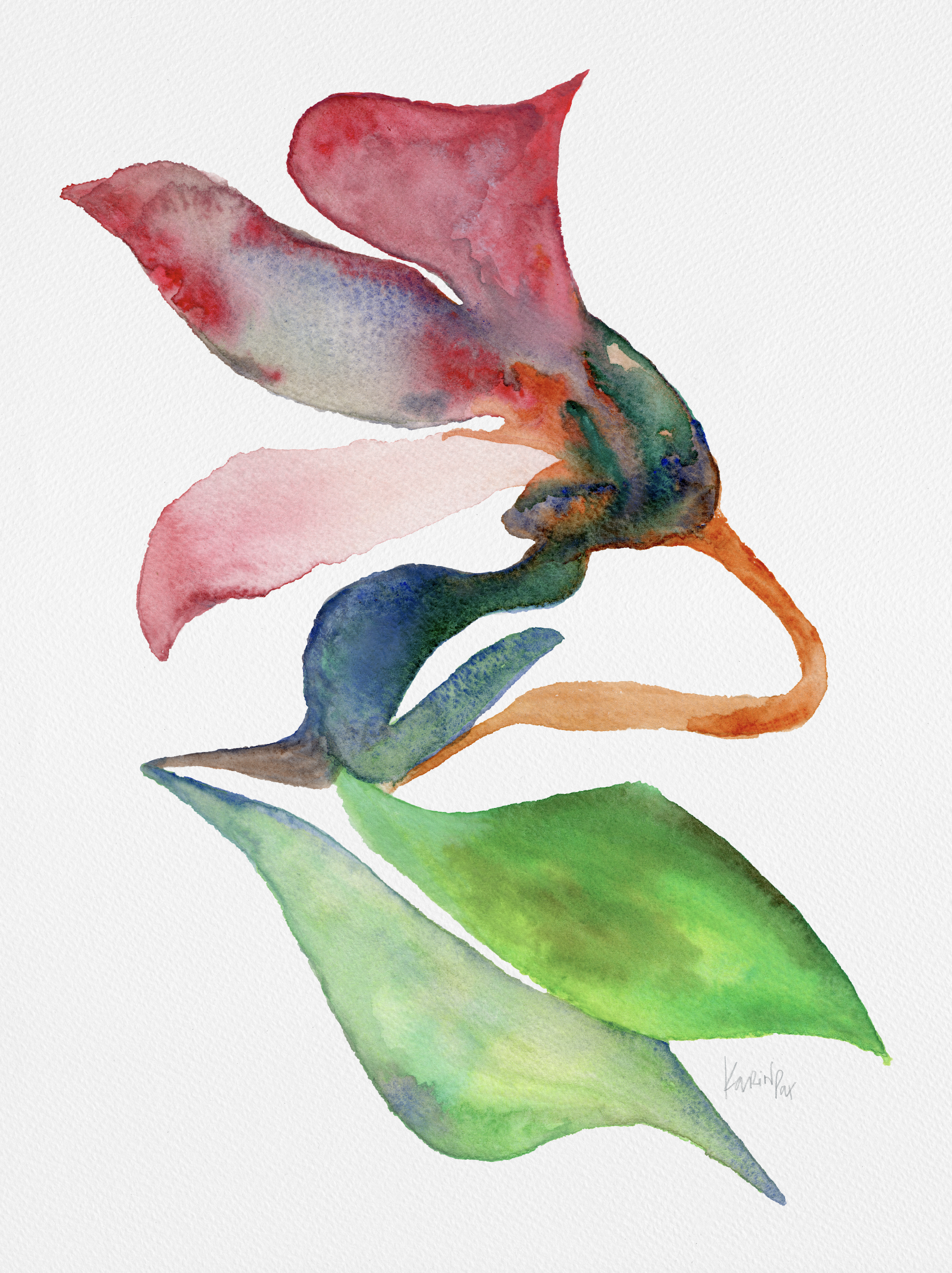
Bright Dark Shadow by Karina Da Paixao Teixeira
In all these years lived, I am starting to understand that my dark side is made of bright colours.
The dark teal and orange are holding everything together, while red and green pull away.
The dark isn't absence of colour. It's where all the colours meet.
Sometimes my art is nothing. Sometimes it is the argument. The argument made visible before I had the words for it.
This one, I think, is about the shadow.
Not shadow as darkness. Not shadow as the part of you that needs to be fixed or excavated or apologised for. Jung's shadow is everything the ego couldn't hold. Everything that wasn't safe to be. The child learns quickly, which parts of you get love, which parts get silence. The unacceptable parts don't disappear. They go underground. They become the shadow.
And here is what nobody tells you: the shadow holds your colours too.
The creativity that was too much. The ambition that wasn't appropriate. The grief that made people uncomfortable. The intensity that was always being managed down. These don't only live in the shadow as wounds. They live there as unrealised brightness. Jung called it the golden shadow. I call it the dark teal holding everything together while the red and green are still deciding whether they're safe enough to open.
I work with anger a lot. And what I keep finding underneath the anger is not badness. It's a part that was never allowed to exist in any other form. Suppressed long enough, it comes back as rage. As unconscious self-destruction. As the question: why do I keep doing this?
Making the unconscious conscious. That's Jung's provocation. Acceptance and Commitment Therapy (ACT), one of the therapeutic frameworks I work within, arrives at the same territory differently. Not through symbols and dreams but through contact. Through stopping the fight with your own experience. Through making room for the parts you've been avoiding without letting them run everything.
Both are asking the same thing: stop exiling yourself from yourself.
When I say my dark side is made of bright colours, I am not being poetic. I am describing what integration actually feels like from the inside. The rage that becomes assertiveness. The neediness that becomes the capacity for real intimacy. The ambition that stops being shameful and becomes direction.
The painting was first. The words came after.
That's usually how it works for me. And maybe that's its own kind of argument, that sometimes the right hemisphere gets there before the left. That the hand knows something the mind is still working out.
I am still working it out.
With curiosity and care for your story, Karina
Living Between Lack and Loss
On absence, meaning, and what the body carries when there is nothing to grieve
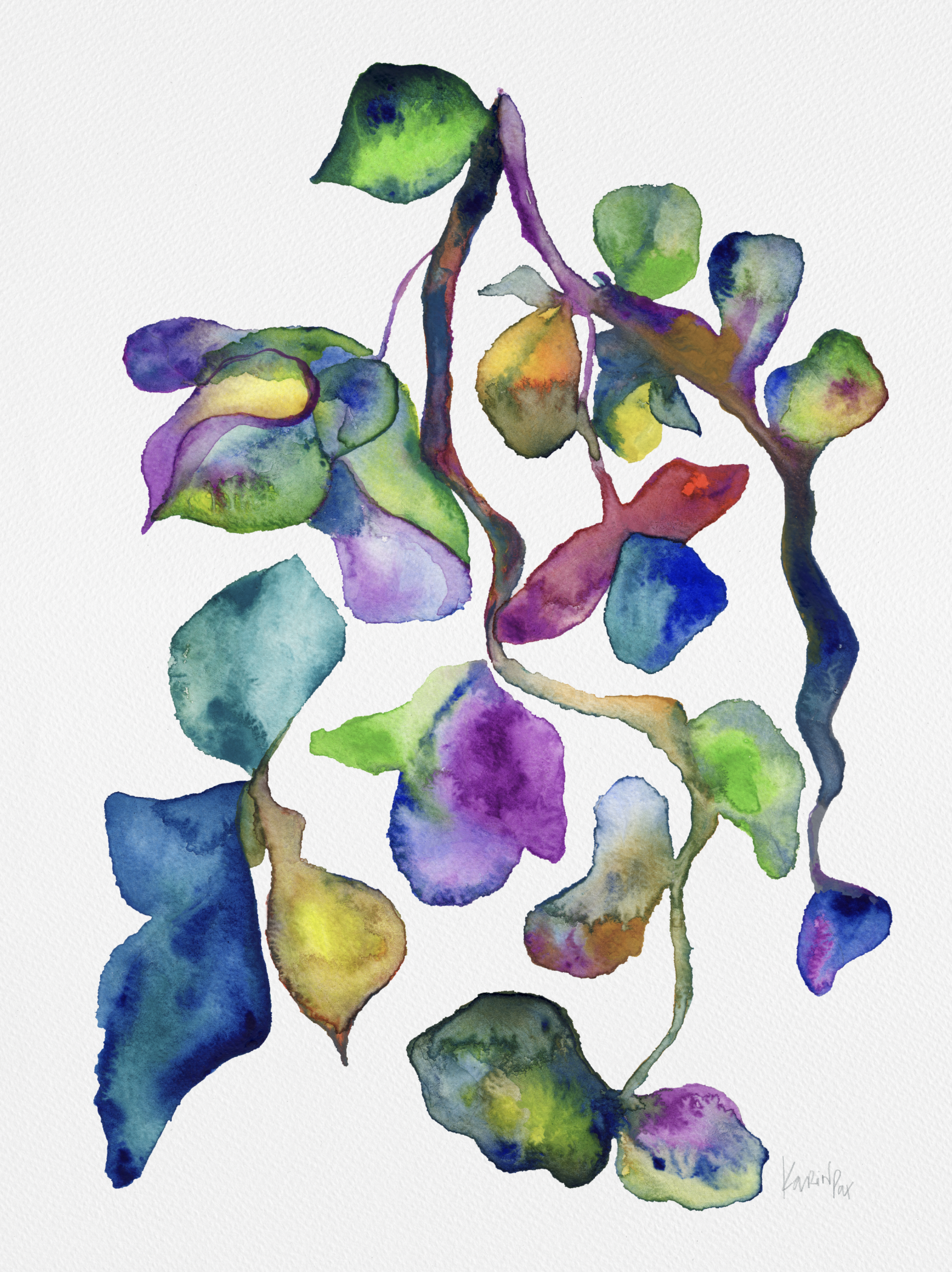
Unconscious by Karina Da Paixao Teixeira
I was bush walking and I thought: we may live between lack and loss.
I didn't plan the thought. It arrived the way thoughts do when you stop trying to have them. I kept walking. I let it settle.
Loss I can name and it has a shape. There is a before and an after. Something that was present and then became absent. You can point to the place where it was. You can build a grief around it, however long and complicated that grief turns out to be.
But what happens when the thing was never there to begin with?
There is no memory to grieve. No moment to return to. Just an absence that somehow still takes up space, still organises the way you move through the world, still shapes what you expect from other people, what you believe you deserve, what feels possible and what quietly doesn't.
That is lack. And I have been trying to understand the difference for a long time. Not just clinically. From the inside.
The hunger without a name
Pauline Boss, a family therapist who has spent decades studying what she calls ambiguous loss, gives us one way to approach this. She is writing primarily about situations where someone is physically present but psychologically absent. A parent with dementia. A partner who has withdrawn. A family member whose grief or addiction or mental illness means they are in the room but not quite there. The loss is real but it has no clean edges, no funeral, no moment of official ending. And without that, the grief has nowhere to land.
I think of ambiguous loss as one territory within the larger country of lack. Because there is a particular kind of lack that happens in childhood, when the parent is physically present, feeding you, housing you, perhaps even loving you in their own limited way, and still somehow not seeing you. Not getting to know you. Being too consumed by their own survival, or their own damage, or the family dynamics that were set long before you arrived, to turn toward you with genuine curiosity about who you are.
You were loved, perhaps. And simultaneously, you were nobody to anyone.
Both of those things can be true. That is part of what makes it so difficult to name.
A narrative
Let me bring you into something.
Maybe you lost both parents. In different stages of your life, your mother first, and then thirty years later, your father from old age. During the grief, something unexpected arrives alongside the sadness. Anger. Not the clean anger of loss, but something older and more confused.
You realise, in the grief, that they passed away without ever really knowing who you were. Not your child self. Not your adult self either. And you didn't truly know them. You never fully trusted them. There was love, you believe that, but there was also a brother who commanded the family's attention like a gravity, and parents who orbited him, and you who fought your whole life simply to exist on your own terms, to make your own choices, to not be managed or diminished or decided for.
You fought for your freedom. And you won it, mostly. But the fight left something behind.
When you were a child, you were loved. So you forgave them. You hold that. But the evidence of your life, the choices others made around you, the way you were positioned in your own family, the experience of being a stranger in the place that was supposed to be home, all of it confirmed something you had no words for yet. That you were somehow peripheral. That the central story was happening somewhere else and you were adjacent to it, watching from a slight distance, never quite at the centre of anything.
And then there was the assault. Something that happened to your body that you had no opportunity to speak about, no adult who created the space for that truth. So it went somewhere else. Into the architecture of the self. Into the way you understood what safety meant, and who could be trusted, and what you were worth.
That is what I mean by the assault on meaning. Not just what happened. What it concluded, silently, about who you were.
What the research says, and what surprises me about it
I have been reading research on experiential avoidance, the tendency to block, minimise, or refuse to integrate painful internal experience, in relation to trauma and PTSD.
What surprises me, every time I return to it, is this: avoidance itself is not the primary driver of prolonged suffering. Boeschen and colleagues found that the effect of experiential avoidance on psychological outcomes was real but small. What actually predicted PTSD severity, what explained the most variance in who recovered and who didn't, were disrupted core beliefs. The assault on meaning. The shattering of what a person had understood about safety, trust, self-worth, and their place in the world.
The wound is not primarily in the avoidance of memory. It is in what the experience concluded about who you are.
Lewis and colleagues, writing more recently, make a distinction I find useful here. They separate trait experiential avoidance, the general dispositional tendency built up over years of learning that certain feelings are dangerous, from state experiential avoidance, what you actually do in a specific difficult moment. The trait is the background hum. The state is what happens when the context demands something your system has learned not to tolerate. What their research found is that in interpersonal contexts, in situations of social and relational stress, state avoidance mediates how intensely the suffering is felt. Not in contexts of physical discomfort. In relational ones.
That is not a surprise to me. Lack is a relational wound.
The impossibility of resolving an original absence
I don't know how to resolve this section, and I'm not sure I should try.
You can grieve a loss. Grief has a shape, even when it is complicated and non-linear and arrives in waves you didn't expect. There is something to move through, even if the moving takes years.
But how do you grieve something that was never there?
Winnicott understood something about this. He wrote about the mother's emotional responsiveness as foundational, not just to the child's sense of security, but to the formation of the self. When that responsiveness is absent or inconsistent, the child doesn't just feel unsafe. The child develops around the absence. Builds a self that accommodates the gap. The true self, Winnicott would say, learns to hide. And what presents to the world is the self that learned to manage.
That managed self can be very competent, very capable, can build a meaningful life and love people and do remarkable things. I believe that. I have seen it. I have lived it. But underneath, the hunger remains. The shapeless longing for something that cannot be named because it was never experienced. You cannot remember what you never had. You can only feel its absence as a kind of pressure, a reaching that doesn't know what it is reaching for.
I notice this in the consulting room. A client who unconsciously asks too much of their child, not from selfishness but from a desperate need to be known by someone, finally, completely. The child becomes the first person they have truly hoped would see them. That is not a failure of parenting. It is the original wound finding its way to the surface through the nearest available relationship.
The research on attachment confirms what clinical observation suggests: early relational patterns shape not just how we relate to others, but how we relate to our own interior states. The insecurely attached child learns that certain feelings are not safe to have. Avoidance is not just a coping strategy. It is a relational training, beginning before language.
How to live here
I don't have a clean answer to this, and I think the absence of one is part of the truth of this territory.
The work is not primarily about recovering what was lost. With lack, there is nothing to recover. What was not given cannot be retrieved. The work is something different. It is the slow construction of a different relationship with the self. Learning to be the witness the original environment didn't provide. Learning to turn toward the absence with curiosity rather than shame, to ask, with genuine interest, what this hunger has been trying to tell you about what you need, what it has organised in you, what it has, despite everything, made possible.
I have a theory that trauma can also lead you to a meaningful life, even when the confusion still comes. I hold that from experience, not as a consolation but as an observation. The people I have known who carry the deepest lack are often also the people with the most extraordinary capacity for attention, for creativity, for the kind of empathy that comes not from theory but from having lived inside difficulty for a long time.
That doesn't make the lack worth it. I want to be careful not to say that.
But living between lack and loss is not only a story of what was missing. It is also the story of what was built in that space. What had to be invented because it couldn't be inherited.
And that, the inventing, is worth something.
The painting above is Unconscious. The leaves are still connected to the vine, most of them. But several have already drifted. Each one a different colour, a different weight. The ones at the edges have gone a deep blue, almost indigo. They let go some time ago. I painted this before I knew what this Reflection would say. I think the painting knew first.
With curiosity and care for your story,
Karina
If you're curious…
Boeschen, L. E., Koss, M. P., Figueredo, A. J., & Coan, J. A. (2001). Experiential avoidance and post-traumatic stress disorder. Journal of Aggression, Maltreatment & Trauma, 4(2), 211–245.
Lewis, M. M., Naugle, A. E., Katte, K., & DiBacco, T. A. (2024). The indirect effects of state experiential avoidance on trait experiential avoidance and negative affect in the moment. Current Psychology, 43, 6284–6296.
Boss, P. (1999). Ambiguous Loss: Learning to Live with Unresolved Grief. Harvard University Press.
Winnicott, D. W. (1960). The theory of the parent-infant relationship. International Journal of Psychoanalysis, 41, 585–595.
Fonagy, P., Campbell, C., & Luyten, P. (2023). Attachment, mentalizing and trauma: Then (1992) and now (2022). Brain Sciences, 13(3), 459.
When EMDR Met My Body
On trauma activation, the window of tolerance, and what happens when a practitioner becomes the client
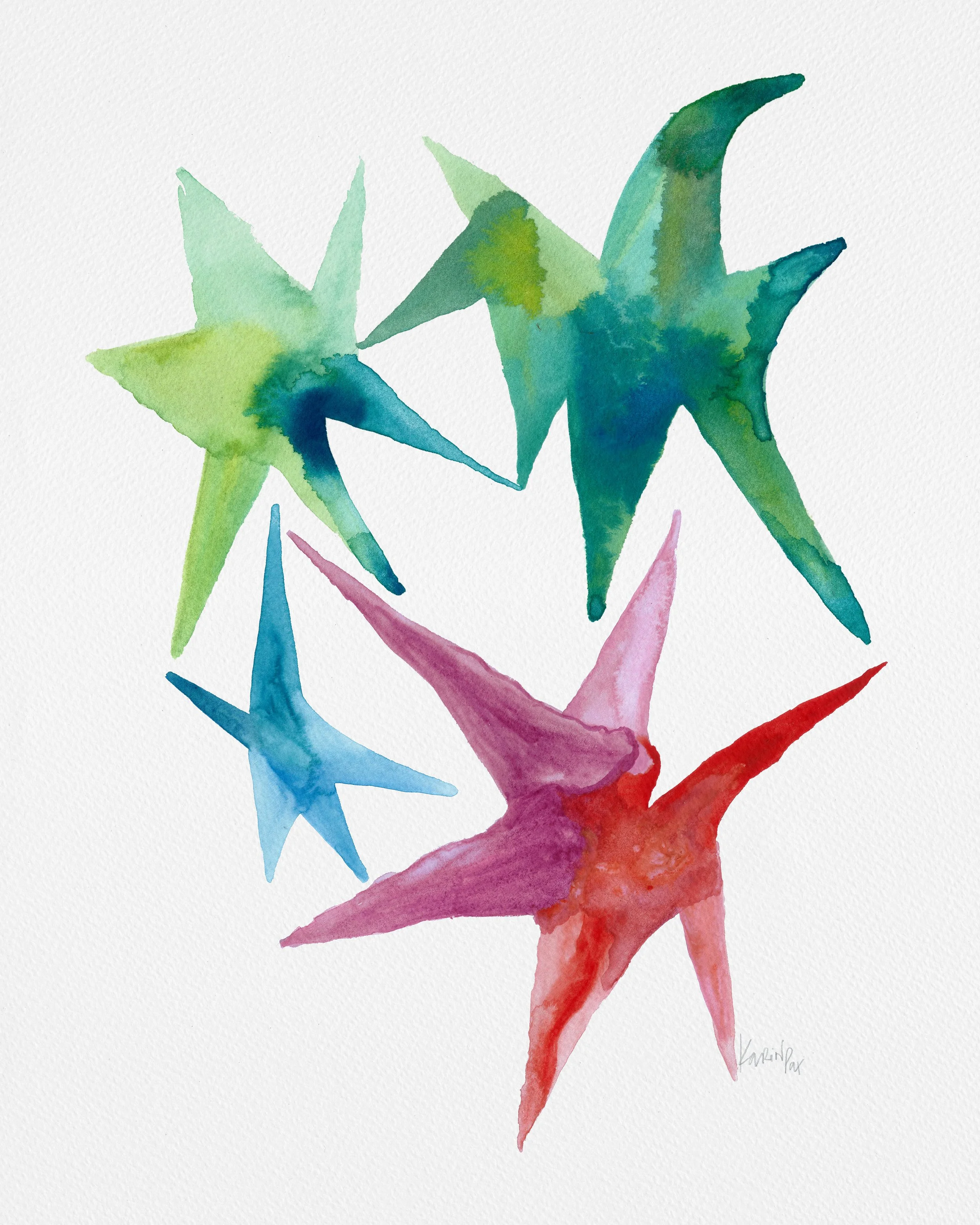
Starry by Karina Da Paixao Teixeira
I couldn't write for three weeks. For three weeks, the part of me that makes things went quiet. Not writer's block. The right brain, shut down by trauma activation. The system had other priorities.
Three weeks without words, without painting, without the thing that has been my most reliable form of regulation since I can remember. If you have read my previous reflections, you know what that means for me. Writing and painting are not hobbies. They are how I think. How I stay in the present. How I know I am still here.
EMDR took them from me. At least for a while.
I want to be careful about how I say what follows. I am a counsellor. I understand trauma treatment. I know the research on EMDR, I know Shapiro's theoretical framework, I know the ISSTD guidelines on dissociative presentations. I went into those sessions informed.
And still. What I experienced in the weeks that followed was not integration. It was rupture.
I am writing today partly because I am back. And partly because I think this needs to be said.
What I believe about trauma work
My view, formed through clinical practice and through living inside complex trauma, is this: working with trauma does not mean immersion in trauma. It does not mean the deliberate evocation of traumatic memories as a first move, or a fast move, or sometimes any move at all.
What it means, most of the time, is gradual and indirect approach. As Judith Herman understood and wrote about decades ago, it is fundamental to revisit traumatic experience from a position of safety in the present. That word, safety, is not administrative. It is neurobiological. Without it, the work cannot land. And it is the most precious word in my life.
Complex trauma presents with somatisation and dissociation, and both of these matter clinically and personally. Somatisation is not performance. It is the unconscious, genuine neurological consequence of chronic threat exposure: dysregulation of the autonomic nervous system and the HPA axis. The body carries the imprint of what the mind could not fully process. Muscle tension. Chronic pain. Visceral sensitivity. Altered interoception.
Dissociation is the psyche's defence against what is otherwise unbearable. A disruption of consciousness, memory, identity, and perception. And in complex trauma, the kind that begins early, before there is language for it, before there is any framework to hold it, dissociation is not a symptom that sits alongside the presentation. It is the architecture.
This is where EMDR, which I respect as a modality, requires a more honest conversation.
What Shapiro understood, and what I want to add
According to Shapiro's theoretical framework, traumatic memories are frozen in an unprocessed state, stored with their original affect, sensation, and distorted cognition intact. They cannot connect with the adaptive memory networks that would allow integration: the contextualising, the neutralising, the sense that this happened then, and I am here now.
Bilateral stimulation, the eye movements, the tapping, the auditory tones, is proposed to support dual attention. The person holds the traumatic material in mind while remaining anchored in the present. This dual awareness is what distinguishes EMDR from simple immersion, in theory. The adaptive information processing model is genuinely elegant.
But I want to bring awareness to something the research does not always foreground. EMDR does involve deliberate activation of traumatic memory. And for clients with significant dissociation, that activation, without sufficient stabilisation, without an adequately wide window of tolerance, without Phase 1 work that has actually done what it needs to do, can produce something other than integration.
It can produce rupture.
The ISSTD guidelines are clear on this: caution is required with highly dissociative clients, not because EMDR is immersion per se, but because trauma activation without sufficient stabilisation can trigger dissociative switching and destabilisation. A client with significant affect dysregulation, a fragile therapeutic alliance, or a narrow window of tolerance is not yet a candidate for trauma activation work. The question is not which modality to use. The question is whether Phase 2 is appropriate at all. EMDR's sophistication does not bypass that assessment.
I need to say something else here. Something I am still working out in supervision.
I may bring bias to this reflection. I am personally addressing pre-verbal trauma with active PTSD symptoms. I am the client I am writing about, at least in part. And EMDR has been a genuinely difficult experience for me, one that has led to repeated episodes of splitting between the apparently normal part of daily functioning and the emotionally charged part, where my hypervigilance activates and fixes in trauma time.
I am trying not to drop out of EMDR therapy. But I am close.
What I know from the inside
As many people living with complex trauma know: you don't always know whether a memory is really a memory.
When you are a child, a young adult, you carry suppressed anger and a suspicious relationship with everything, but you don't truly know whether what you remember is the truth. It is so fragmented. All those flashing images. I have them while awake, and occasionally just before falling asleep. I have wondered, for as long as I can remember, how it happens to others, that unpredictable recollection of traumatic moments, arriving without warning in the middle of the day.
Perhaps that is one of the reasons I became a nurse and a psychotherapist. I believe I can read people's silent suffering in their eyes, in their physiology. Even when I don't want to see it. A mirror you want to avoid, because you don't want to think that others have had experiences like the ones that surface, out of nowhere, in the middle of an ordinary afternoon.
In complex trauma, people live between two extremes. Hyperarousal: explosive anger, intense shame spirals, panic, emotional flooding, rapid escalation, difficulty self-soothing. And hypoarousal: emotional numbness, flat affect, disconnection, the inability to access or name feelings, anhedonia. The oscillation between these states is cruel. The worst of it is the unpredictability, which destabilises relationships and creates a pervasive distress that becomes its own significant source of shame.
I return again to Siegel's and Ogden's window of tolerance, because in complex trauma this window is often so narrow it is barely a window at all. Learning, reframing, connection, and integration are only possible when the client is within it. And here lies the core of my concern about premature trauma activation. Not about EMDR as a modality. About timing. About readiness. About the difference between a protocol that is theoretically sound and a client who is somatically not ready for what that protocol asks.
What the body knows before the mind catches up
When I look at what happens in complex trauma, there is a sequence. An overwhelming experience. A nervous system unable to cope or integrate. Dissociation that splits off the unbearable. Unprocessed affect stored somatically. And then body symptoms, dysregulated emotion, intrusive memories, all of which are, despite feeling unbearable, precious information.
They tell you that what happened, happened. The intrusive memories causing the splitting are not imagination. They are cues. The material is fragmented, emotionally and psychologically disorganised. But it is real.
Even as a mental health practitioner with knowledge and personal practice in self-regulation, I have struggled with emotional numbing, identity confusion, and amnesia for trauma material. All considered moderate signs of dissociation. I have supported others through mental health crises, professionally, steadily, and yet I find myself at another step of post-traumatic growth while it is almost unbearable.
You are not alone in this. I am trying to navigate a specific chapter of trauma work, and it seems impossible to simply switch off the defensive responses that are disturbing to both brain and mind. These responses are not failures. They are the system doing what it was built to do, in conditions it was built to handle.
The problem is that the danger is no longer present. The system has not received the update.
The silence before this sentence
I usually write every day. The last two weeks were impossible, following the EMDR sessions.
I call it the silent despair: you function through life, but it feels as though the darkness never quite lets you go. You hold it through the workday, through parenting, through the clinical hours where you are present for someone else's fragmentation. And then you get home and there is nothing left for your own.
What I know now, clinically and personally: I went into those sessions carrying decades of complex, relational, and developmental trauma with attachment disruption. I went with trust. But without adequate Phase 1 preparation. And what happened was that trauma activation outpaced stabilisation.
I know this. I knew it before I could write it here. But knowing something clinically and living it are two very different things.
The fact that I am writing today matters. That is what I want to say to you, if you are in the middle of it: the fact that you are still here, still trying to put words to it, still in the room with your own experience, that matters.
The part that is also structural
There is something I want to say about access, because I think it would be dishonest to leave it out.
Medicare's structure, the limited number of sessions, the expectation that things can be resolved in a handful of appointments, means that people like me are sometimes sent directly into trauma activation work without the stabilisation phase that should precede it. The assessment of readiness gets compressed. The preparation gets abbreviated. And then the person is left holding what got activated, without adequate support to contain it.
I am a single mother. An immigrant. Building a practice. A registered nurse, three or more days a week. These are not obstacles I am listing for sympathy. They are the full picture of what I am holding. And the irony of being someone who understands trauma treatment deeply, while being unable to access the version of it I actually need, is not lost on me.
EMDR has brought suppressed material to the surface. I believe that. I hope it is ultimately for the best. But as a client, I feel that whatever integration I had achieved through previous therapeutic work, these sessions have significantly disturbed it. Perhaps it is simply too much adverse experience for the nervous system to organise calmly. What remains good, and I am looking for what remains good, is that I am learning. The limitations and the possibilities. And that before long I hope to reflect from some distance, and evaluate with more clarity whether EMDR is genuinely safe for most complex trauma presentations.
I have many grounding tools. For the first time, they are not working.
And yet, when I am stuck, as a client, as a therapist, I find I am also curious. Because being stuck always means more learning. More reframing. More understanding of what the brain is trying to do and why.
The researchers say the goal is to increase integration and expand the window of tolerance, so the client no longer needs to fragment in order to survive the present moment. I believe that. I am living toward it.
So, if today is a day when you are thinking of giving up on your trauma work, or on therapy altogether: you are not alone. Feeling my own affect dysregulation, trying to calm my hyperarousal after a flashback, it is suffering. But it is also informative enough to allow me to hold this pain and observe my own inner experience with something approaching compassion.
That, for today, is enough.
With curiosity and care for your story,
Karina
If you're curious…
Herman, J. (1992). Trauma and Recovery. Basic Books.
Van der Hart, O., Nijenhuis, E.R.S., & Steele, K. (2006). The Haunted Self: Structural Dissociation and the Treatment of Chronic Traumatization. Norton.
Shapiro, F. (2018). Eye Movement Desensitization and Reprocessing (EMDR) Therapy: Basic Principles, Protocols, and Procedures (3rd ed.). Guilford Press.
ISSTD (2011). Guidelines for treating dissociative identity disorder in adults, third revision. Journal of Trauma & Dissociation, 12(2), 115–187.
When the Body Remembers What the Mind Cannot Reach
A counsellor, registered nurse and survivor writes on why talk therapy is not always enough for trauma, and what the body holds that narrative cannot reach.
On somatosensory approaches to trauma, and why the body has to be part of the conversation

Rose in Solitude by Karina Da Paixao Teixeira
I am writing a book on intrusive memories. It may become a fictional autobiography about my traumas and my ongoing experiences of disturbing recollection of fragmented memories from childhood. It has to be fictional, here and there, because my perpetrators are alive. In my own journey to survival, I became an artist, a registered nurse and a therapist. So, I have a theory that trauma can also lead you to a meaningful life, even when confusion still comes.
I have been studying Experiential Reframing and other somatosensory approaches because I see effectiveness on both chronic psychosocial and existential trauma. Before I go further, it is worth being precise about what those two things actually are, because the distinction matters clinically.
Chronic psychosocial trauma is repeated relational harm that accumulates over time, within the systems a person depends on for safety. This is where childhood trauma occurs. No way to fight or flight. It includes emotional or physical abuse, neglect, domestic violence, community violence, prolonged bullying. What makes it particularly complex is that the harm is interpersonal and often comes from attachment figures, which means the nervous system cannot fully distinguish between the source of threat and the source of safety. The schemas that form around this kind of trauma tend to be deeply embedded because they were built slowly, reinforced repeatedly, and organised around survival within a relationship. Van der Kolk's work is useful here: the body encodes this kind of chronic exposure differently from a single event, often producing a diffuse, pervasive dysregulation rather than a clean trigger-response pattern.
Existential trauma is different. It refers to acute events that threaten life or bodily integrity. A car accident, an assault, a medical emergency, a natural disaster. The threat is sudden and external, and while the nervous system response is equally powerful, the event itself has a beginning and an end. There is often a clearer narrative around it. The cognitive and perceptual systems, while disrupted, are working with a bounded experience.
The key clinical distinction is this: chronic psychosocial trauma tends to produce character-level adaptations, what Jeffrey Young would call early maladaptive schemas, because the repeated experience shaped how the person came to understand themselves, others, and the world during development. It is much more than a scar. The imprint of fragmented memories built the architecture. Existential trauma, by contrast, tends to produce a rupture in a previously more stable sense of self and world. The person knew who they were before. The work is different in each case.
Why the body has to be part of it
Traumatic memory is primarily perceptual and somatic, not narrative. It is encoded during high cortisol states when the hippocampus is partially offline, so it does not get stored as a coherent story you can simply talk through. It gets stored as fragmented sensation, body states, and conditioned fear responses. You can narrate the event without touching the encoded experience.
This is the neurobiological reality: trauma memories are not stored in the prefrontal cortex, where rational thought lives. Trauma is visceral. It is stored in the body, in the experience of fight, flight, freeze, or submit. When signals are sent to the brain, often as a wrong prediction of threat, those memories are triggered without conscious awareness. The individual feels them physically, not intellectually.
This is why cognitive restructuring can fail to reach the implicit and nonverbal components of trauma. It is also why a significant number of clients drop out of exposure treatments. They cannot sustain the somatosensory weight of what gets activated in the retelling process, leaving past trauma alive and activated rather than moving toward resolution. Talk therapy is not enough. Not here.
Rather than entering through narrative and thinking downward into the body, somatosensory approaches enter through the body and work upward. The body is the gateway, not the destination.
Experiential Reframing and the somatosensory search
Rogers and White's research on Experiential Reframing is interesting in this context. Their somatosensory search approach makes particular sense for chronic trauma, where cognitive search tends to either miss the material entirely or land on the wrong thing. The body holds what the narrative cannot access.
Rather than asking someone to cognitively recall what happened, you ask them to feel their way back through the body's memory. That is a meaningful clinical distinction, and it aligns with van der Kolk, Porges's polyvagal work, and Ogden's sensorimotor approach. Trauma work in this frame might begin with psychoeducation, discussing with a client the neurobiology of trauma, how conditions and environment cause nervous system injuries, how encoding affects both memory and response. And crucially, resources are identified first: the successful strategies a client has already developed, before moving toward traumatic material. The client's own experience of coping becomes part of the treatment.
I say this not only as a clinician. Because of my own intrusive memories and flashbacks, I understand from the inside what Rogers and White describe: trauma as the result of poor integration between the cognitive and perceptual memory systems. That is not an abstract definition. It is something you live.
On resistance, and what Erickson understood
Cognitive Behavioural approaches help, but not always with clients who are presenting resistance. This is where I borrow from Ericksonian paradoxical interventions.
Symptom prescription: a person with insomnia is instructed to stay awake as long as possible. Restraining change: the therapist advises not to move too quickly. By removing the pressure, ambivalence decreases and motivation increases. In reframing, we change the meaning of the symptom without changing the fact. Anxiety becomes a system of alertness rather than a malfunction. Utilisation takes this further: the client's resistance itself becomes part of the therapeutic process. If a client is sceptical, that scepticism becomes part of the induction. Whatever the client brings is useful material.
Erickson also understood that strategic positioning and contradiction from the therapist can disrupt rigid patterns of thinking, creating a cognitive opening in which new responses can emerge.
Why does this work? Because, as Victor Carrión's work on Cue-Centered Therapy makes clear, PTSD feeds on avoidance. Paradoxical prescription removes the effort of suppression. And when a client chooses to produce a symptom on instruction, they demonstrate control over something they believed was uncontrollable. That shift, from helplessness to agency, is itself therapeutic. These techniques often bypass the conscious, critical mind and speak more directly to unconscious patterns. Erickson knew this. Posttraumatic growth has a way of teaching it too.
I want to be clear about something. These interventions are most effective when delivered within a trusting therapeutic relationship and calibrated carefully to the individual. Used clumsily or without sensitivity, they can feel manipulative. Erickson's genius was partly in his exceptional attunement to each person, which made techniques that look strange on paper feel natural and even obvious in the room. They have since influenced strategic therapy (Haley), brief therapy (MRI/Watzlawick), and narrative approaches, and remain a rich area of study.
This is food for thought, drawn from research, from practice as a counsellor and registered nurse, and from my own survival. We still need further substantial research on the neurobiology of trauma to establish Experiential Reframing's effectiveness with the rigour it deserves. But the direction feels right. The body has been trying to tell us something for a long time.
With curiosity and care for your story,
Karina
If you're curious...
Carrión, V. G. (2016). Cue-Centered Therapy for Youth Experiencing Posttraumatic Symptoms: A Structured, Multi-Modal Intervention. Oxford University Press.
Erickson, M. H. (1985). Life Reframing in Hypnosis. Irvington.
Ogden, P., Minton, K., & Pain, C. (2006). Trauma and the Body: A Sensorimotor Approach to Psychotherapy. Norton.
Porges, S. W. (2011). The Polyvagal Theory: Neurophysiological Foundations of Emotions, Attachment, Communication, and Self-Regulation.
Norton.
Rogers, S. D., & White, S. L. (2017). Experiential reframing: A promising new treatment for psychosocial and existential trauma. Practice Innovations, 2(1), 27–38.
van der Kolk, B. (2014). The Body Keeps the Score: Brain, Mind, and Body in the Healing of Trauma. Penguin.
Young, J. E., Klosko, J. S., & Weishaar, M. E. (2003). Schema Therapy: A Practitioner's Guide. Guilford Press.
What Depression Protects
On rumination, the loop that won't stop, and why depression often has an architecture underneath it that medication alone cannot reach.
On rumination, the loop that won’t stop, and the frustration of trying to reach someone who has stopped believing they can be reached

Hyperarousal by Karina Da Paixao Teixeira
As a counsellor working across inpatient mental health units and private practice, I have learned that depression is one of the most complex presentation to work with, clinically. Because it is persistent. Because it returns. Because it organises itself around beliefs that feel, to the person carrying them, like simply the truth.
I want to write today about a frustration I feel in this work, one I think is worth naming rather than managing quietly. It is the frustration of sitting with someone who has been on medication for years, who is compliant, who is trying, and whose thinking is still caught in the same loop. Still returning to the same guilt. Still unable to leave the house without someone beside them. Still, after all this time, without hope.
As a therapist, this frustrates me. I am frustrated with what is being missed.
I want to explore what that is.
The system I work in
For context: in the mental health units I have worked in, the window for inpatient treatment is typically 21 days. In a private hospital setting, a multidisciplinary team has that window to help a person stabilise, begin to build capacity, and leave with something more than a revised prescription.
Twenty-one days is both a lot and very little, depending on what the person is carrying.
What I encounter most often in these presentations is not a person who hasn’t tried. It is a person who has been compliant with medication for years, sometimes decades, and whose dysfunctional thinking is still present, still organising their experience, still shaping what feels possible and what doesn’t. The biological treatment is addressing the neurotransmitter imbalance. Something else is not moving.
If the chemistry is being treated, what is maintaining the depression?
A case I keep thinking about
I want to tell you about someone I’ll call Anna.
Anna had not left her house without her husband in two years. She came into hospital following a deterioration that was visible in her body as much as her mind. Cognitive slowing. Psychomotor slowness. A quality of hopelessness that is different from sadness, more total, more certain of itself. She had been on antidepressants for a long time. They had not been enough.
Her history was one of profound early loss. A mother who was absent through repeated hospitalisation. A father who was abusive. From a very young age, she had functioned as her own parent, and in doing so had built a particular internal architecture: the belief that her needs were too much, that love was conditional, that the only safety available was the kind she could secure through vigilance and control.
That architecture had been running quietly for decades. The depression was not separate from it. The depression was, in a real sense, its current expression.
What struck me in working with Anna was how organised her suffering was. The rumination was not random. It returned, again and again, to the same beliefs. The same guilt. The same sense that she had failed in ways she could not quite name. This is what I mean when I say depression has an architecture underneath it. The thoughts are not symptoms so much as the structure speaking.
Why medication is not enough here, and what the research actually says
Aaron Beck understood something important early in his work on depression. The symptoms, the low mood, the fatigue, the withdrawal, were not the problem itself. They were the surface. Underneath was a structure: a set of beliefs about the self, the world, and the future that had become rigid, distorted, and self-confirming.
The depressed person does not just feel bad. They feel bad because of what they believe. And what they believe, they have believed with quiet certainty for a very long time.
This distinction matters clinically. Antidepressants work on the amygdala, our threat detection system, dampening the intensity of the alarm signal. That is genuinely useful. The person becomes available for the work that actually needs to happen. But the prefrontal cortex, where meaning is made, where the self reflects on itself, where the beliefs generating the depression actually live, that is where psychotherapy works. And they are not the same place.
A 2023 meta-analysis of over 52,000 participants, the largest of its kind, found that psychotherapy is equally effective as medication in the short term, and significantly more effective over time. I think medication does not build anything.
Medication removes a symptom. Psychotherapy installs a capacity.
The relapse rates on medication discontinuation are two to three times higher than for those who have also done the psychological work. I am not surprised by this. You cannot medicate a belief.
What rumination is actually doing
This is where I want to slow down, because I think rumination is often misunderstood as a symptom to suppress rather than a signal worth investigating.
Rumination is organised. It is loyal. It returns to the same beliefs because those beliefs are doing something, holding something in place that the system has decided must be held.
In Anna’s case, the guilt she carried about an inheritance dispute was not arbitrary. It activated a much older schema about not deserving care, about receiving love being dangerous. The rumination was, in a distorted and exhausting way, an act of loyalty to something. A vigilance that made sense once, in a childhood where not being vigilant had consequences.
Jeffrey Young’s schema therapy framework gives us language for this. The core schemas formed in early life, emotional deprivation, abandonment, defectiveness, vulnerability, these are not distortions to be corrected so much as conclusions that made sense given what a child experienced. The problem is not that they formed. The problem is that they never got updated.
Empathic confrontation is the term used in schema therapy for what is required here. Not confrontation in the sense of challenge or argument. Confrontation in the sense of gently, persistently, with warmth, refusing to collude with the schema’s version of reality. Chipping away, as I tend to think of it. Not breaking. Chipping. Slowly, carefully, over time.
The instinct when someone is in the loop of rumination is to interrupt it. But the more effective question is: what is this loop protecting? What does the system believe will happen if the certainty is released?
What the body holds that the mind cannot always reach
I have been reading Payne, Levine and Crane-Godreau on somatic experiencing, and something in it connects to what I observe in the room.
Levine’s work argues that trauma and chronic stress are not primarily psychological. They are a dysregulation of the body’s core response network, subcortical, autonomic, limbic. The nervous system under threat encodes the experience not as a story but as sensation, posture, the particular quality of readiness or collapse that becomes the body’s baseline.
This is why people can understand their depression intellectually, trace the patterns, name the beliefs, and still wake at three in the morning with a heaviness that does not respond to any of that knowledge. The story has been processed. The body has not received the memo.
For Anna, this meant that the cognitive work had to be accompanied by the body noticing something different. Not just thinking differently. Experiencing differently.
The walks outside the hospital
I want to tell you about the graduated exposure work we did with Anna, because it is the most concrete example I have of what I mean.
Anna had not left the building without her husband. The anticipatory catastrophising was total. Something bad will happen. I will lose control. I will not be able to manage.
We started with very small steps. And then she went for walks outside the hospital grounds. Not because the anxiety wasn’t there. It was there. The hyperarousal was present, the expectation of panic. The work was learning to stay with that experience rather than flee it. To discover, incrementally, that the feeling was survivable. That she could tolerate what she had believed she could not.
Each time she returned from a walk, something had shifted slightly. We don't find changes on her beliefs, yet. In her evidence. In what her own experience was beginning to tell her about herself.
This is what behavioural experiments do that cognitive restructuring alone cannot. They bypass the argument between the rational mind and the belief. They put the body in a situation and let it discover something new.
After many walks, she became confident in her own ability to self-regulate. That confidence did not come from thinking. It came from doing, from the nervous system accumulating a different kind of evidence.
Giovanni Liotti’s work on disorganised attachment and the therapeutic relationship is relevant here too. For someone like Anna, whose early attachment figures were also sources of fear and harm, the therapeutic relationship itself becomes part of the intervention. The experience of being in a relationship that is safe, that holds, that does not withdraw when things become difficult, is not incidental to the treatment. It is the treatment.
What I am still learning
I want to say something about rumination that I don’t have fully resolved.
The paradox of suppression is well established: the more we try not to think a thought, the more present it becomes. The standard approach, rumination postponement, scheduled worry time, creating distance from the loop without demanding it stop, helps. But I find the breaking of the rumination loop one of the more complex problems in this work, and I want to say that honestly.
What I observe is that the loop tends to break not through suppression or through direct challenge, but through the gradual development of a different relationship with the thoughts. The thoughts become less sticky not when the person stops having them, but when the thoughts stop feeling like facts. When there is enough space between the person and the belief that they can observe it rather than be entirely inside it.
Acceptance and Commitment Therapy points in this direction. You are not the thought. The thought is something that passes through.
That shift, from identification with the thought to observation of it, is slow. It does not follow a straight line. And I say this from both sides of the therapeutic relationship: there is no quick fix here. But progress can happen in a shorter time than people expect, if the intervention is targeting the right level.
Why I keep studying this
I have seen cases of genuine recovery from depression that everyone, including the person, had stopped believing was possible. I have also seen people give up on their lives. Both realities stay with me.
The frustration I feel when I sit with someone who has been on medication for years and is still in the loop, is not frustration with them. It is a kind of urgency that I have come to think of as part of the work. It keeps me reading. It keeps me returning to the research. It keeps me asking what else is possible, what I might be missing, what intervention might reach what the previous ones haven’t.
Depression is not a simple problem. It does not have a single cause or a single solution. But I believe strongly, and the research increasingly confirms, that the architecture underneath the depression is where the work needs to land. The beliefs that were formed, the schemas that organise the present through the lens of the past, the body that learned to carry what the mind could not name.
That is where the heaviness lives. And that is where something can, slowly, begin to shift.
If you recognise this loop, the one that returns at three in the morning, the beliefs that feel like facts, the sense that the life you are living is not quite yours, I want you to know that the loop is not a permanent feature of who you are. It is a pattern that was learned. And what was learned can, with the right conditions and the right support, begin to be updated.
The painting above is Hyperarousal, one of my watercolours. The forms are in motion, distinct and restless, nothing settled into background yet. That is what this work looks like from the inside of it.
With curiosity and care for your story,
Karina
If you’re curious…
Beck, A. T. (1979). Cognitive Therapy of Depression. Guilford Press.
Cuijpers, P. et al. (2023). Cognitive behaviour therapy vs. control conditions, other psychotherapies, pharmacotherapies and combined treatment for depression: a comprehensive meta-analysis including 409 trials with 52,702 patients. Cognitive Behaviour Therapy, 52(1), 1–25.
Gautam, M. et al. (2020). Cognitive behavioral therapy for depression. Indian Journal of Psychiatry, 62(S2), S223–S229.
Liotti, G. (2012). Disorganized attachment and the therapeutic relationship with people in shattered states. In J. Yellin & K. White (Eds.), Shattered States: Disorganised Attachment and Its Repair. Taylor & Francis.
Payne, P., Levine, P. A., & Crane-Godreau, M. A. (2015). Somatic experiencing: using interoception and proprioception as core elements of trauma therapy. Frontiers in Psychology, 6, 93.
Voderholzer, U. et al. (2024). Enduring effects of psychotherapy, antidepressants and their combination for depression. Frontiers in Psychiatry, 15, 1415905.
Young, J. E., Klosko, J. S., & Weishaar, M. E. (2003). Schema Therapy: A Practitioner’s Guide. Guilford Press.
Young, J. E., & Klosko, J. S. (1994). Reinventing Your Life. Plume. (If you’re looking for a place to begin understanding schema patterns in your own life, this is an accessible and genuinely useful starting point.)
The Fear Beneath the Ritual
On OCD, uncertainty, and what becomes possible when we name what is really happening
On OCD, uncertainty, and what becomes possible when we name what is really happening
Finding Hope by Karina Da Paixao Teixeira
There is something that happens in the body before the ritual begins.
Before the checking, the counting, the returning to make sure. Before the thought that arrives uninvited and refuses to leave. Before all of it, there is a sensation. Urgent, relentless, impossible to reason with. Most people who live with OCD know this sensation intimately. Many have spent years trying to make it stop.
We call it anxiety. And we are not wrong. But there is a question I keep returning to in my clinical work, one that I think changes something important about how we understand what is actually happening.
What if the root is not anxiety? What if, beneath the anxiety, there is something older and more specific?
What if the root is fear.
Anxiety and fear are not the same thing
This distinction matters more than it might initially seem.
Anxiety is diffuse. It spreads across situations, across time, across possibilities. It is the hum of threat that colours everything without always having a precise object.
Fear is different. Fear has a target. It is the nervous system’s response to something it has learned is dangerous, whether or not that danger is real in the present moment. Fear says: this is the thing. This is what we must not let happen.
In OCD, that thing is usually uncertainty itself.
Chris Brewin’s dual representation theory, which I wrote about in my previous Reflection on intrusive memories, helps us understand why certain fears become lodged in the nervous system rather than processed and filed away. The same mechanism that keeps traumatic memories alive in the body operates in OCD. The amygdala, our threat detection system, has learned that uncertainty equals danger. And it responds with everything it has.
The compulsion, then, is not irrational behaviour. It is the nervous system’s most logical solution to an intolerable feeling. If I check one more time, I will know. If I repeat this sequence, the fear will ease. If I can be certain, I will be safe.
And it works. Briefly. Which is exactly why it continues.
What the ritual is protecting
I want to say something here that I think gets lost in most clinical descriptions of OCD.
The fear is not the enemy.
It is a protector. A part of the self that learned, somewhere along the way, that uncertainty was dangerous. That not knowing was not safe. That vigilance was necessary for survival. This part is not broken. It is loyal. It is doing exactly what it was shaped to do.
The compulsion is an act of loyalty to that frightened part. And before we can ask someone to give it up, I think we have to honour what it has been trying to do.
When I sit with clients who carry OCD, what I find most useful is not to fight the fear or to talk them out of it. It is to turn toward it with genuine curiosity. To ask: what is this part of you trying to protect? What does it believe will happen if the certainty is not achieved? What is the original wound beneath the ritual?
These are not easy questions. But they are worth asking. Because when the fear is finally seen, really seen, not as an enemy to be defeated but as a signal worth understanding, something begins to shift.
The joy of a different relationship
There is something that becomes possible when you stop treating your own complexity as a problem.
We are not simple. We are not supposed to be. The parts of us that developed compulsive patterns, intrusive thoughts, ritualised behaviour, these parts were responding to something real. They deserve to be met with the same compassion we would offer anyone who learned the wrong lesson under difficult conditions.
When a client begins to turn toward their fear with curiosity rather than combat, something opens. Not immediately. Not linearly. But gradually, the investigation itself becomes interesting. The question shifts from “why am I like this” to “what is this telling me about myself.” And that shift, from self-judgment to self-curiosity, is where something genuinely new becomes possible.
This is what I mean when I say that psychological exploration can be a source of joy. Not because the work is easy. But because knowing yourself, really knowing yourself, is one of the most meaningful things a human being can do.
The fear beneath the ritual is not your enemy. It is an invitation. To look. To understand. To meet the parts of yourself that have been working very hard, for a very long time, to keep you safe.
They are worth knowing.
This drawing is the source of the pattern I used in my previous Reflection. The original before the repetition. That felt right for a post about what lives beneath compulsive behaviour, something fluid and alive, waiting to be recognised.
With curiosity and care for your story,
Karina
If you’re curious...
Brewin, C. R. & Holmes, E. A. (2003). Psychological theories of posttraumatic stress disorder. Clinical Psychology Review, 23(3), 339–376.
van der Kolk, B. (2014). The Body Keeps the Score. Penguin.
Abramowitz, J. S. et al. (2023). Cognitive-behavioral therapy for obsessive-compulsive disorder. Psychiatric Clinics of North America, 46(1), 167–180.
Eisenbeck, N. et al. (2024). Intolerance of uncertainty as a cognitive vulnerability for obsessive-compulsive disorder. PMC.
Why Some Memories Refuse to Fade
On trauma, the body, and the strange persistence of the past
On trauma, the body, and the strange persistence of the past
Intrusive Memories by Karina Da Paixao Teixeira
It arrives without warning.
Not as a thought, exactly. A smell that doesn’t belong to the present moment. A tightening in the chest before the mind has caught up with what caused it. A flash of image, not quite a picture, not quite a feeling, that seems to come from nowhere and land everywhere at once.
If you have experienced this, you already know what I am describing. And you may also know the particular confusion that follows: the sense that something is happening that the rational mind cannot fully account for. You were fine a moment ago. And now you are not. And there is no clean explanation for the distance between those two states.
This is what an intrusive memory feels like from the inside. It is not a recollection, but an arrival.
There is something in the clinical literature that begins to explain what is happening, and something beyond the literature that I keep returning to, something harder to name but closer to the truth of what I observe in sessions and in myself.
I want to try to put both of those things together here.
Why these memories are different
Most of our memories behave themselves. They sit in the past where we left them. When we recall them, we know we are recalling. There is a felt sense of distance, a recognition that this happened then and we are here now. The memory is a story we can tell.
Traumatic memory does not work this way.
Chris Brewin’s dual representation theory offers one of the most useful frameworks I have encountered for understanding why. The theory proposes that traumatic memories are encoded differently from ordinary autobiographical memories. Ordinary memories are stored in a way that allows for narrative recall. They can be placed in time, contextualised, told as a story with a beginning and an end. Traumatic memories, particularly those formed under conditions of extreme fear or overwhelm, are stored differently. They are encoded as sensation, image, and fragment. They live in the body and the senses rather than in the storytelling mind.
This is why they do not feel like the past. They feel like now.
Bessel van der Kolk describes how the brain under trauma encodes experience in the sensory and emotional systems rather than in the narrative centres. The hippocampus, which normally helps us place experience in time and context, is compromised under extreme stress. The amygdala, our threat detection system, encodes the fear directly, raw, uncontextualised, ready to fire again the moment a similar cue appears. The memory does not come with a timestamp. It arrives as if it is still happening.
Recent research in Nature Human Behaviour confirms what many trauma survivors already know from lived experience: intrusive memories are specifically linked to fear rather than to emotion in a general sense. This distinction matters more than it might initially appear. The fear is not a response to remembering. The fear is the memory. And that changes what we might need to do about it.
What I notice in the room
I want to be careful here, because I am aware that I am moving from research into something more personal. But I think this is where the most honest thinking lives.
In my clinical work, and in my own experience, intrusive memories rarely announce themselves as memories. They announce themselves as present-tense distress. A client will describe a sudden wave of panic in a completely ordinary situation, on a train, in a supermarket, hearing a particular tone of voice. They will often say, with a kind of bewildered shame: I don’t know why that happened. Nothing was wrong.
But something was right. Something in the environment matched a stored fragment, a sensory detail, a quality of light, a sound, a feeling of powerlessness, and the nervous system responded accordingly. Not to the present moment, but to the past one that the body still cannot quite file away.
This is not irrationality. This is the nervous system doing exactly what it was designed to do: protect you from something it learned was dangerous. The problem is that it learned the lesson under conditions that made precise encoding impossible. So it stored the danger signal without storing enough context to know when the danger has passed.
What looked like a malfunction is actually a faithful record. A record that has simply never been updated.
The body keeps the account
I am struck, in this work, by how little language has to do with it.
People can talk about their trauma for years. They can narrate it coherently, understand it intellectually, even make meaning of it, and still have their bodies respond as if the event is ongoing. The story has been processed. The body has not received the memo.
Peter Levine writes about trauma as incomplete action. The body prepared to fight or flee, and then could not, and the energy of that preparation was stored rather than discharged. The memory is not just a psychological record. It is an unfinished physical event.
This is why so many people find that understanding their trauma is not enough. They can explain what happened. They can see the patterns it created. They can trace the ways it has shaped their life. And still, without warning, the body takes them back.
The work, then, is not only cognitive. It is not only about making sense of the story. It is about helping the nervous system learn, slowly and with great patience, that the danger is over. That the body can put down what it has been holding.
That is slow work. It is non-linear. It requires more than words.
Sometimes that is what this work looks like, fragments finding each other, slowly, until something whole begins to emerge.
With curiosity and care for your story,
Karina
If you’re curious...
Brewin, C. R. (2001). A cognitive neuroscience account of posttraumatic stress disorder and its treatment. Behaviour Research and Therapy, 39(4), 373–393.
van der Kolk, B. (2014). The Body Keeps the Score. Penguin.
Levine, P. (2015). Trauma and Memory. North Atlantic Books.
Varma, M. M. et al. (2024). A systematic review and meta-analysis of experimental methods for modulating intrusive memories. Nature Human Behaviour, 8(10), 1968–1987.
What Integration Actually Means
On timing, readiness, and what it means when the body finally decides it is safe enough to feel
On timing, readiness, and what it means when the body finally decides it is safe enough to feel
Borbo Pattern by Karina Da Paixao Teixeira
There is a word that gets used a lot in therapy circles. Integration. Therapists say it the way architects say structure, the way nurses say stable. It sounds clinical. Contained. Like something that happens on a whiteboard with arrows pointing in the right direction.
I have been thinking about what it actually means.
Integration, in the way I understand it, is not a technique. It is not a stage you complete and move past. It is something closer to what happens when parts of you that have been living in separate rooms finally begin to hear each other through the walls.
Daniel Siegel offers an image I find more honest than most. He talks about the difference between a fruit salad and a smoothie. Integration is not blending everything into one indistinguishable thing. It is allowing each part to remain itself, distinct, while also being in relation to the others. The apple does not become the grape. But they share the bowl.
I think about this when I sit with clients who carry childhood trauma into their adult lives. The child is still there. Not metaphorically. In the vocabulary they use when they are flooded. In the posture they take when they feel cornered. In the way they go very quiet, or very loud, or completely elsewhere. The adult consciousness has formed around the child, not through it. And at some point, the work is to let those two meet.
Recovery from trauma is non-linear. Most people who have lived it already know this, even if no one has said it to them directly. You do not move from wounded to healed in a straight line. You move sideways, and sometimes backwards, and sometimes you are fine for months and then something small undoes you completely and you do not understand why.
Iris Brooke Gildea, a survivor, poet and therapist whose autoethnographic research on flashbacks and poetry I find deeply resonant, describes what she calls the “emergency stage.” The period when intrusive memories surface with force, when the survivor is no longer certain what is real memory and what is imagination, when the body seems to be working against itself.
I saw this often in psychiatric wards. The flashbacks that made it almost impossible to stay in a body. The chronic effort of trying to remain in reality. The metabolic cost of years of unaddressed trauma showing up in blood pressure, in sleep, in the immune system. It is not worth it. I say this as a registered nurse and as a counsellor.
But here is what I have come to believe, and what I try to hold alongside clients when this stage arrives: the emergency is not an attack. It is a signal. The nervous system, in its strange and demanding way, is saying: you are ready now. The adult consciousness has arrived. Something in the system has updated, and it is asking you to look at what was stored before you were able to look.
As cruel as that sounds, there is something almost tender in it.
A case that stays with me. A survivor whose own trauma began very early in childhood, before there was language for it or any framework to hold it. For most of her adult life, the memories had been organised into something manageable. Not resolved. Organised. She described certain images from childhood as things she had always assumed were just “weird imagination.” The shaking that came and went. The nightmares that never fully left.
Then her own child reached the age at which the abuse had begun.
Something activated. Flashbacks arrived. Panic attacks. An overwhelming protectiveness that became its own kind of weight, overreactive and exhausting, extending into a parenting approach that carried all the vigilance of what had not yet been processed. The child she was trying to protect was hers. But the fear was older than that.
This is what the body does. It remembers the age, even when the mind has found other ways to file things. And when the calendar arrives at that number again, something in the system responds.
What looked like breakdown was actually the beginning of readiness.
The integration, when it begins, does not feel like resolution. It feels more like recognition. The adult self turns toward the younger self, not to fix it or silence it, but to say: I see you. I can hold this now. You do not have to carry it alone anymore.
That shift, from being flooded to being able to witness, is where something begins to change. Victor Carrión’s cue-centred approach, which I have used with both young people and adults, offers a way of reframing intrusive memories not as threats to be suppressed, but as cues. Information from a part of the self that is ready to be addressed. When we receive the imagery that way, something in the nervous system begins to settle. The nightmares become less frequent. The panic becomes less total. Not because the memory is gone, but because it has been met.
Acceptance and Commitment Therapy points in a similar direction. Rather than fighting what arises, we learn to let it be present without letting it govern. We make room. We do not become the feeling. We hold it.
The connection to others, for survivors, can feel like it happens through glass. Even those who appear highly functional, who hold jobs and relationships and look, from the outside, completely fine. There is often a distance operating beneath the surface. Whether that is dissociation in a clinical sense, or something softer, a self-protective spacing that made perfect sense once and has simply not yet been updated. That question sits at the back of my mind often. Not as a clinical question, exactly. More like a human one.
Integration is not a destination. It is what happens when we stop asking the different parts of ourselves to pretend the others do not exist. When the child is allowed to be part of the adult story, rather than hidden underneath it.
It is slow. It is non-linear. It asks a great deal.
And it is, I think, the realest thing therapy can offer.
The painting above is Borbo Pattern. The same motif that began as a butterfly mid-dissolution appears here multiplied, interlocking, each form distinct and yet inseparable from the whole. That is what integration looks like to me.
With curiosity and care for your story,
Karina
If you’re curious…
Brooke Gildea, I. J. (2020). The emergency stage: flashbacks and poetry: an autoethnographic approach. Journal of Poetry Therapy, 33(2), 110–122.
Carrión, V. G. (2019). Cue-Centered Therapy for Youth Experiencing Posttraumatic Symptoms. Stanford University Press.
Siegel, D. J. (2010). Mindsight: The New Science of Personal Transformation. Bantam Books.
van der Kolk, B. (2014). The Body Keeps the Score. Penguin.
Tell Your Truth in a Fiction Novel
On narrative therapy and the courage to rewrite from the inside
On narrative therapy and the courage to rewrite from the inside

Her Novel by Karina Da Paixao Teixeira
Today I reflect on cognitive reframing, narrative therapy, and fictional autobiography as a therapeutic tool. Writing your story from a distance, especially in a fictional or third-person frame, is a well-researched pathway for trauma processing. The narrative distance helps the nervous system engage with complex and difficult material without being flooded by overwhelming somatic experiences. When you write, you are out of automatic mode. The automatic mode that Daniel Kahneman called, in his book Thinking Fast and Slow, "System 1" of the cognitive architecture of the brain. Creating a story, even one about your trauma, requires the activation of Kahneman's "System 2": the effortful and deliberate part of your brain that demands attention and mental energy.
I remember a patient I was seeing at a mental health unit who would shake non-stop, suffering from prolonged grief after losing his wife. The doctors were worried about cognitive deterioration. I introduced a few games with him, and since we started playing, the shaking stopped completely. I administered the Montreal Cognitive Assessment (MoCA) to collect evidence, and he did not make a single mistake. No signs of deterioration in cognitive function, orientation, language or memory. I repeated the same approach with war veterans. We played games of creating stories, and again and again, people emerged from their suffering and physical symptoms of trauma. I understood that relief comes when we engage the creative, meaning-making part of the brain.
What if you didn't have to tell it as fact?
The woman in this artwork, surrounded by colour and growth, is my attempt to show what I believe about how narrative therapy works. The invitation is to write your story from the inside. This illustration came to me while I was reading How to Write an Autobiographical Novel by Alexander Chee, a collection of essays about truth, memory, and the self that is brave enough to put itself on the page. It is not official research, but I have been learning that the story we carry doesn't need to be told as fact in order to begin the healing process. It is not about avoiding the truth, but finding a form that can hold the truth without collapsing under its weight.
Narrative therapy was developed by Michael White and David Epston, and it invites us to understand that we are not our problems. We are the authors of our own stories. Authors. Do you see the shift in perspective? It is about giving a different ending, or at least, a different relationship to the beginning. I believe that cognitive reframing works in a similar direction, because when we look at a painful memory or a difficult belief from a slight distance, when we step outside it even briefly, the nervous system gets a moment of relief. The memory, which has been living in the present tense, begins to find its place in the past. It becomes something that happened, rather than something that is always happening.
This is what I mean when I say: tell your truth in a fiction novel.
James Pennebaker spent decades studying expressive writing and what happens when people write about difficult experiences. What he found, consistently, across many studies, is that expressive writing reduces physiological stress, calms the nervous system, and over time, decreases the intrusive quality of painful memories. The body responds. Not because the writing fixes anything, but because giving form to what has been formless is itself a kind of relief. Peter Levine, who has written so beautifully about trauma and the body, describes how traumatic memory is often stored not as a clear narrative but as sensation, image, fragment. Bessel van der Kolk, whose work I return to often, reminds us that what we cannot yet say in words, we carry in the flesh.
And this is where poetry, fiction, image, where art enters as something more than metaphor. It enters as a genuine therapeutic tool. Because art doesn't need linearity. It doesn't need a beginning, middle and end. It can hold the fragment. It can be the fragment, and still make something whole.
Iris Brooke Gildea, a survivor, poet and therapist whose autoethnographic research on flashbacks and poetry I find deeply resonant, describes the act of writing through trauma not as constructing a cohesive narrative, but as becoming the author-witness of your own experience. That small shift, from being inside the storm to also watching it, naming it, giving it colour, is where something begins to change.
I recognise this from my own practice and lived experience. Not clinically. From the inside.
The fictional distance is not a lie
When I first encountered the idea of fictional autobiography as a therapeutic form, something settled in me. The idea that you can write toward your truth through a character who shares your history, your body, your fear, but has a different name, a different face, enough distance that the nervous system doesn't flood, felt like both a creative and a clinical insight at once.
Alexander Chee does this. Many of the writers I admire most do this. They tell the truth slant, as Emily Dickinson once said. And in that slant, they find something truer than a direct account might have reached. This is not avoidance. Avoidance keeps the story locked. This is an approach, careful, creative, at a pace the body can tolerate.
When we write in third person, or in fiction, or in metaphor, we create what researchers call narrative distance. And that distance is not a lie. It is a way of staying in the room with something difficult long enough to begin to understand it.
As I have shared from my own experience as a counsellor, somatic symptoms, the body's way of carrying what the mind hasn't yet processed, can begin to soften through this kind of writing. Not always. Not for everyone. Not as a replacement for therapy. But as a companion to it, or sometimes as a beginning.
What this looks like in practice
It doesn't need to be beautiful. That is the first thing I would say.
It doesn't need to be coherent or literary or finished. Brooke Gildea wrote her way through her own emergency stage in coffee shops and on floors, in fragments and verse that broke every grammatical rule, and that fragmentation was the point. The disjointed form mirrored the disjointed experience. The writing didn't clean it up. It witnessed it. And witnessing, it turns out, is enough to begin.
I know this because I have done it myself. I write, I paint, I rewrite. I find myself, as I said in my first reflection, enchanted by my own system. Not because the system is perfect, but because it is mine. It emerged from listening to what my body and my creativity needed, rather than from following a formula.
I encourage the same for you. Not my system. Yours.
What form wants to come? A letter to your younger self, written in the third person? A story where she has a different name but your hands? A poem that doesn't rhyme and doesn't make complete sense and says something true anyway? A painting of the feeling, before the words for it arrive?
There is no wrong way to begin.
An invitation
If something in this reflection has stirred something in you, a memory, an image, a sentence that wants to be written, I invite you to give it five minutes. Not to fix anything. Not to produce anything. Just to begin.
You could write: She was the kind of person who… and see what follows. You could give her your history and a different name and let her speak. You might be surprised by what she has been waiting to tell you.
The painting above is Her Novel. A woman, close to the ground, writing in a field of wild colour. That is the invitation. Not upright and productive. Close to the earth, close to herself.
Writing anyway.
With curiosity and deep respect for your story,
Karina
If you're curious…
Pennebaker, J. W. (1997). Opening Up: The Healing Power of Expressing Emotions. Guilford Press.
Kahneman, D. (2011). Thinking, Fast and Slow. Farrar, Straus and Giroux.
Levine, P. (1997). Waking the Tiger: Healing Trauma. North Atlantic Books.
van der Kolk, B. (2014). The Body Keeps the Score. Penguin.
White, M., & Epston, D. (1990). Narrative Means to Therapeutic Ends. Norton.
Brooke Gildea, I. J. (2020). The emergency stage: flashbacks and poetry: an autoethnographic approach. Journal of Poetry Therapy, 33(2), 110–122.
Chee, A. (2018). How to Write an Autobiographical Novel. Mariner Books.
Reframe Within Reflections
On surviving, self-realising, and everything in between
On the difference between surviving and self-realising
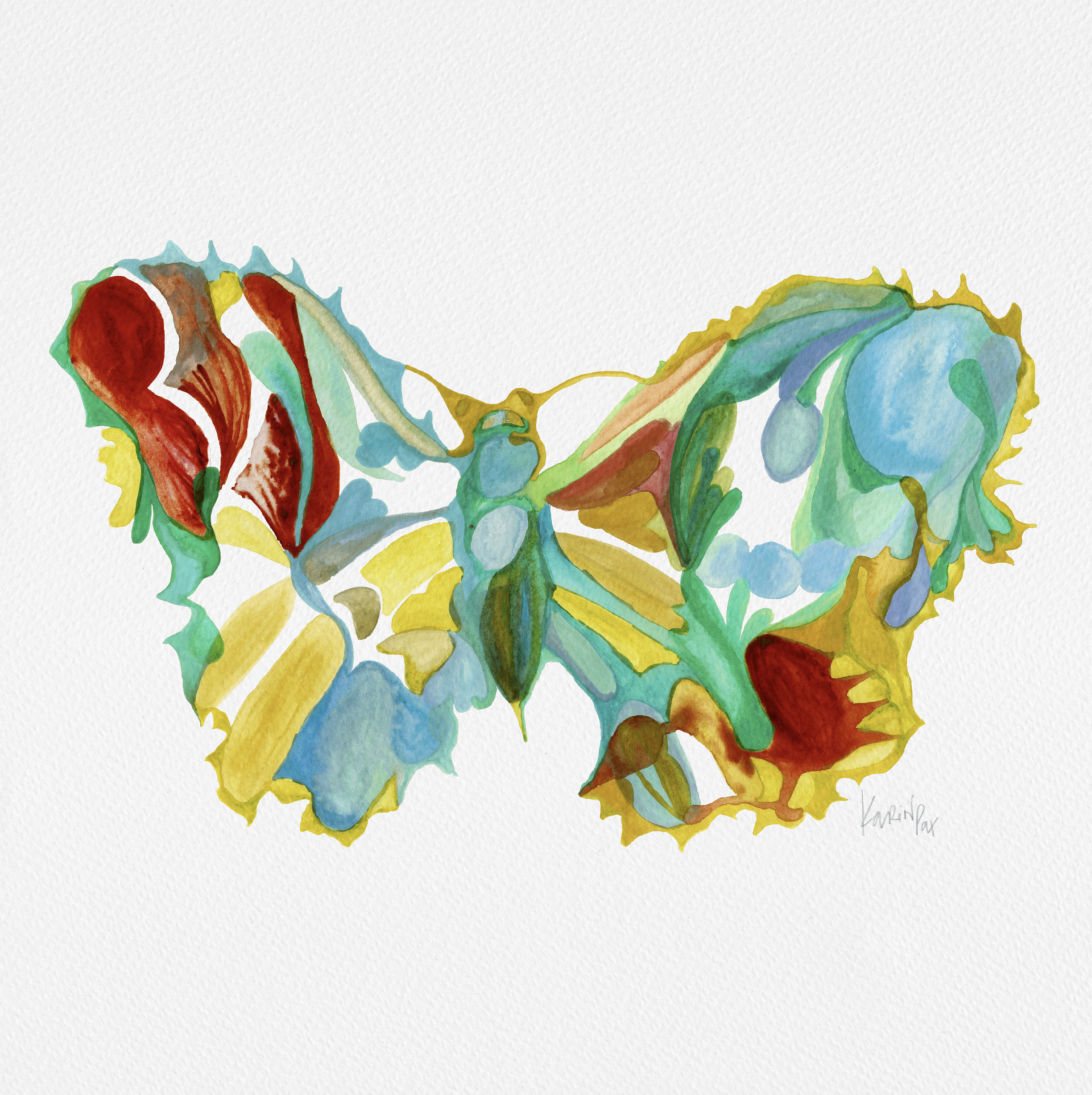
Morph by Karina Da Paixao Teixeira
Welcome to the calm disorganised chaos of my reflections. Please don't expect reflections as per scientific literature or medical framework. I do those too, but not here. This is a safe space for the exploration of self, and to bring empathy to the confusion, because I want to show and observe a process. The writing helps me with the discipline of ongoing evaluation and regulation.
Although based on multiple research papers, because I love reading them, what I write here is probably just my opinion, so take it as food for thought rather than clinical guidance. I am doing this because I have to do it. The same way I listen to the urge to draw or paint something, when I feel it, I have to do it. Counselling as a practitioner illuminates my curiosity for universal human experiences, and I will discuss what my heart wants to put into words.
This week, something surfaced in a conversation with a client that I keep returning to: the difference between surviving and self-realising. I believe in creativity as a way of processing and understanding, and I say that from both sides of the therapeutic relationship.
There are stages. First, you may act in response to trauma, always reacting in survival mode. But I don't really believe that it is all wrong with that. Because as we try to escape, sometimes we also build a meaningful life. By trying to leave a toxic environment behind, even if you don't know what you are doing, you can end up living in different countries, choosing challenge and growing. Later, when we are ready, we do the deeper work. The parts that have been keeping us from fully living our own story. I know it is confusing. That's why reflective thinking and creative practice help.
I have a rich background of professional experiences and adverse events, and I was encouraged by my own inner child to follow my interests with full power and courage. Architecture taught me structure and problem-solving. Nursing gave me practical resilience and the ability to stay emotionally regulated when complex problems arise. A life woven through art, fashion, and design has kept my creativity alive. I rebuilt myself in a country not my own, not once but many times.
These aren't credentials I list. They are the different survival modes I moved through. I believe that becoming a counsellor gave me language to everything I understood from the inside. And that language, that finally having words for the interior life, is part of what self-realisation feels like.
I read, I write, I draw, I paint, I rewrite, I read more, and I find myself enchanted by my own system. I could say this system was put in place as a goal a long time ago, but it is not true. Once, this system was part of a survival strategy. A way to survive childhood.
I listen to feelings and observe my flow, what makes me feel in a state of contentment and like myself, and more or less that is how I established a protective system. Protection for my mental and physical health. And I encourage clients to develop their own tools, because when it feels true to yourself, when you are not forcing, the change happens.
Change is not a clean line. People come to counselling carrying the weight of who they've been, uncertain about who they are becoming. That uncertainty is not a problem to fix. It is the investigation itself.
So, I invite you to meet the wonder, allow it, rather than living in judgment of it. It is worth it, your self-realisation.
We are transformation, morphing into something else. Beautiful imperfections.
The painting above is Morph, my own watercolour. The butterfly mid-dissolution, colours bleeding into each other, not quite one thing yet. That's the space this reflection lives in.
With curiosity and admiration of your emotional and cognitive exploration,
Karina