
Why Some Memories Refuse to Fade
On trauma, the body, and the strange persistence of the past
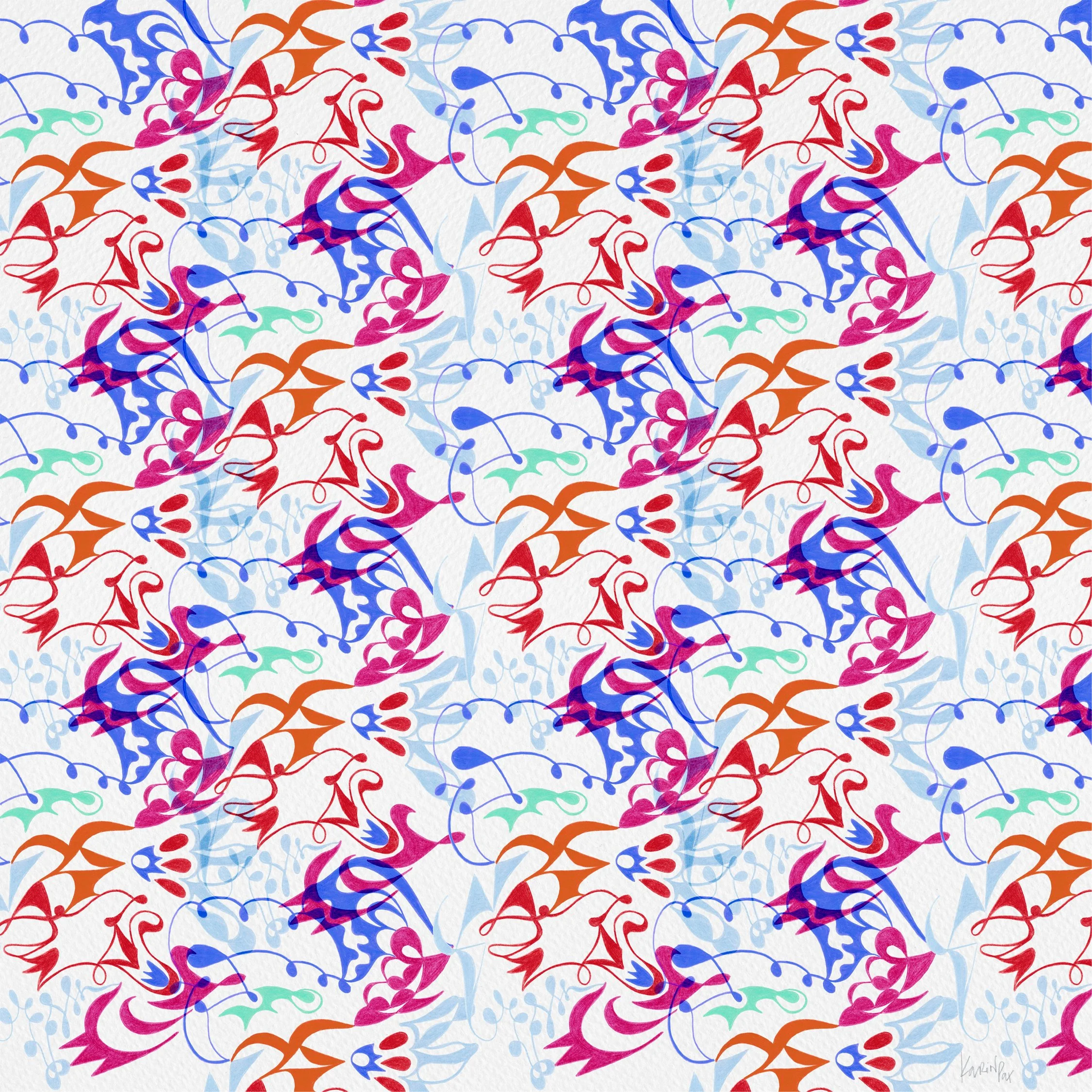
Intrusive Memories by Karina Da Paixao Teixeira
It arrives without warning.
Not as a thought, exactly. A smell that doesn’t belong to the present moment. A tightening in the chest before the mind has caught up with what caused it. A flash of image, not quite a picture, not quite a feeling, that seems to come from nowhere and land everywhere at once.
If you have experienced this, you already know what I am describing. And you may also know the particular confusion that follows: the sense that something is happening that the rational mind cannot fully account for. You were fine a moment ago. And now you are not. And there is no clean explanation for the distance between those two states.
This is what an intrusive memory feels like from the inside. It is not a recollection, but an arrival.
There is something in the clinical literature that begins to explain what is happening, and something beyond the literature that I keep returning to, something harder to name but closer to the truth of what I observe in sessions and in myself.
I want to try to put both of those things together here.
Why these memories are different
Most of our memories behave themselves. They sit in the past where we left them. When we recall them, we know we are recalling. There is a felt sense of distance, a recognition that this happened then and we are here now. The memory is a story we can tell.
Traumatic memory does not work this way.
Chris Brewin’s dual representation theory offers one of the most useful frameworks I have encountered for understanding why. The theory proposes that traumatic memories are encoded differently from ordinary autobiographical memories. Ordinary memories are stored in a way that allows for narrative recall. They can be placed in time, contextualised, told as a story with a beginning and an end. Traumatic memories, particularly those formed under conditions of extreme fear or overwhelm, are stored differently. They are encoded as sensation, image, and fragment. They live in the body and the senses rather than in the storytelling mind.
This is why they do not feel like the past. They feel like now.
Bessel van der Kolk describes how the brain under trauma encodes experience in the sensory and emotional systems rather than in the narrative centres. The hippocampus, which normally helps us place experience in time and context, is compromised under extreme stress. The amygdala, our threat detection system, encodes the fear directly, raw, uncontextualised, ready to fire again the moment a similar cue appears. The memory does not come with a timestamp. It arrives as if it is still happening.
Recent research in Nature Human Behaviour confirms what many trauma survivors already know from lived experience: intrusive memories are specifically linked to fear rather than to emotion in a general sense. This distinction matters more than it might initially appear. The fear is not a response to remembering. The fear is the memory. And that changes what we might need to do about it.
What I notice in the room
I want to be careful here, because I am aware that I am moving from research into something more personal. But I think this is where the most honest thinking lives.
In my clinical work, and in my own experience, intrusive memories rarely announce themselves as memories. They announce themselves as present-tense distress. A client will describe a sudden wave of panic in a completely ordinary situation, on a train, in a supermarket, hearing a particular tone of voice. They will often say, with a kind of bewildered shame: I don’t know why that happened. Nothing was wrong.
But something was right. Something in the environment matched a stored fragment, a sensory detail, a quality of light, a sound, a feeling of powerlessness, and the nervous system responded accordingly. Not to the present moment, but to the past one that the body still cannot quite file away.
This is not irrationality. This is the nervous system doing exactly what it was designed to do: protect you from something it learned was dangerous. The problem is that it learned the lesson under conditions that made precise encoding impossible. So it stored the danger signal without storing enough context to know when the danger has passed.
What looked like a malfunction is actually a faithful record. A record that has simply never been updated.
The body keeps the account
I am struck, in this work, by how little language has to do with it.
People can talk about their trauma for years. They can narrate it coherently, understand it intellectually, even make meaning of it, and still have their bodies respond as if the event is ongoing. The story has been processed. The body has not received the memo.
Peter Levine writes about trauma as incomplete action. The body prepared to fight or flee, and then could not, and the energy of that preparation was stored rather than discharged. The memory is not just a psychological record. It is an unfinished physical event.
This is why so many people find that understanding their trauma is not enough. They can explain what happened. They can see the patterns it created. They can trace the ways it has shaped their life. And still, without warning, the body takes them back.
The work, then, is not only cognitive. It is not only about making sense of the story. It is about helping the nervous system learn, slowly and with great patience, that the danger is over. That the body can put down what it has been holding.
That is slow work. It is non-linear. It requires more than words.
Sometimes that is what this work looks like, fragments finding each other, slowly, until something whole begins to emerge.
With curiosity and care for your story,
Karina
If you’re curious...
Brewin, C. R. (2001). A cognitive neuroscience account of posttraumatic stress disorder and its treatment. Behaviour Research and Therapy, 39(4), 373–393.
van der Kolk, B. (2014). The Body Keeps the Score. Penguin.
Levine, P. (2015). Trauma and Memory. North Atlantic Books.
Varma, M. M. et al. (2024). A systematic review and meta-analysis of experimental methods for modulating intrusive memories. Nature Human Behaviour, 8(10), 1968–1987.