
What Integration Actually Means
On timing, readiness, and what it means when the body finally decides it is safe enough to feel
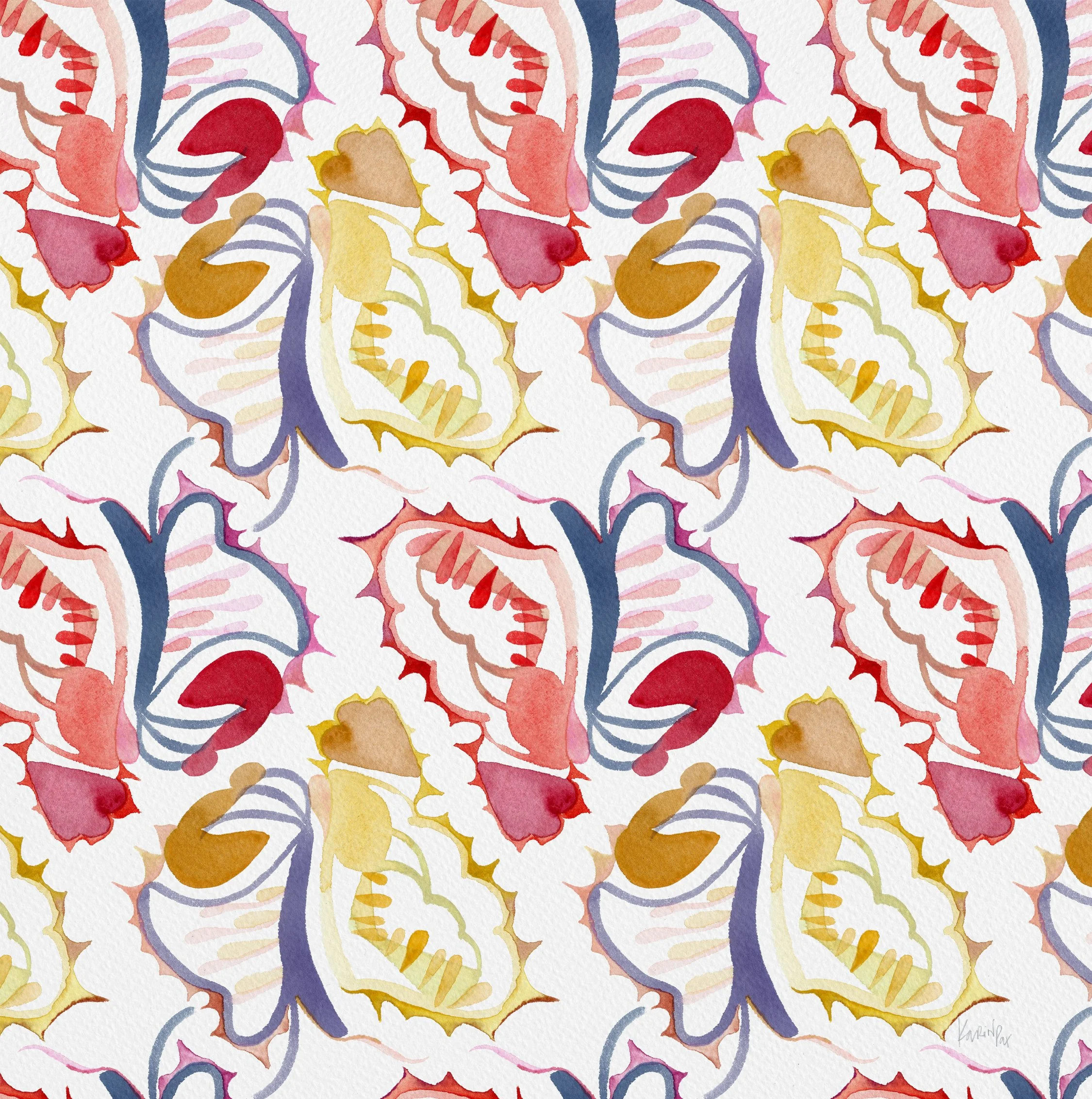
Borbo Pattern by Karina Da Paixao Teixeira
There is a word that gets used a lot in therapy circles. Integration. Therapists say it the way architects say structure, the way nurses say stable. It sounds clinical. Contained. Like something that happens on a whiteboard with arrows pointing in the right direction.
I have been thinking about what it actually means.
Integration, in the way I understand it, is not a technique. It is not a stage you complete and move past. It is something closer to what happens when parts of you that have been living in separate rooms finally begin to hear each other through the walls.
Daniel Siegel offers an image I find more honest than most. He talks about the difference between a fruit salad and a smoothie. Integration is not blending everything into one indistinguishable thing. It is allowing each part to remain itself, distinct, while also being in relation to the others. The apple does not become the grape. But they share the bowl.
I think about this when I sit with clients who carry childhood trauma into their adult lives. The child is still there. Not metaphorically. In the vocabulary they use when they are flooded. In the posture they take when they feel cornered. In the way they go very quiet, or very loud, or completely elsewhere. The adult consciousness has formed around the child, not through it. And at some point, the work is to let those two meet.
Recovery from trauma is non-linear. Most people who have lived it already know this, even if no one has said it to them directly. You do not move from wounded to healed in a straight line. You move sideways, and sometimes backwards, and sometimes you are fine for months and then something small undoes you completely and you do not understand why.
Iris Brooke Gildea, a survivor, poet and therapist whose autoethnographic research on flashbacks and poetry I find deeply resonant, describes what she calls the “emergency stage.” The period when intrusive memories surface with force, when the survivor is no longer certain what is real memory and what is imagination, when the body seems to be working against itself.
I saw this often in psychiatric wards. The flashbacks that made it almost impossible to stay in a body. The chronic effort of trying to remain in reality. The metabolic cost of years of unaddressed trauma showing up in blood pressure, in sleep, in the immune system. It is not worth it. I say this as a registered nurse and as a counsellor.
But here is what I have come to believe, and what I try to hold alongside clients when this stage arrives: the emergency is not an attack. It is a signal. The nervous system, in its strange and demanding way, is saying: you are ready now. The adult consciousness has arrived. Something in the system has updated, and it is asking you to look at what was stored before you were able to look.
As cruel as that sounds, there is something almost tender in it.
A case that stays with me. A survivor whose own trauma began very early in childhood, before there was language for it or any framework to hold it. For most of her adult life, the memories had been organised into something manageable. Not resolved. Organised. She described certain images from childhood as things she had always assumed were just “weird imagination.” The shaking that came and went. The nightmares that never fully left.
Then her own child reached the age at which the abuse had begun.
Something activated. Flashbacks arrived. Panic attacks. An overwhelming protectiveness that became its own kind of weight, overreactive and exhausting, extending into a parenting approach that carried all the vigilance of what had not yet been processed. The child she was trying to protect was hers. But the fear was older than that.
This is what the body does. It remembers the age, even when the mind has found other ways to file things. And when the calendar arrives at that number again, something in the system responds.
What looked like breakdown was actually the beginning of readiness.
The integration, when it begins, does not feel like resolution. It feels more like recognition. The adult self turns toward the younger self, not to fix it or silence it, but to say: I see you. I can hold this now. You do not have to carry it alone anymore.
That shift, from being flooded to being able to witness, is where something begins to change. Victor Carrión’s cue-centred approach, which I have used with both young people and adults, offers a way of reframing intrusive memories not as threats to be suppressed, but as cues. Information from a part of the self that is ready to be addressed. When we receive the imagery that way, something in the nervous system begins to settle. The nightmares become less frequent. The panic becomes less total. Not because the memory is gone, but because it has been met.
Acceptance and Commitment Therapy points in a similar direction. Rather than fighting what arises, we learn to let it be present without letting it govern. We make room. We do not become the feeling. We hold it.
The connection to others, for survivors, can feel like it happens through glass. Even those who appear highly functional, who hold jobs and relationships and look, from the outside, completely fine. There is often a distance operating beneath the surface. Whether that is dissociation in a clinical sense, or something softer, a self-protective spacing that made perfect sense once and has simply not yet been updated. That question sits at the back of my mind often. Not as a clinical question, exactly. More like a human one.
Integration is not a destination. It is what happens when we stop asking the different parts of ourselves to pretend the others do not exist. When the child is allowed to be part of the adult story, rather than hidden underneath it.
It is slow. It is non-linear. It asks a great deal.
And it is, I think, the realest thing therapy can offer.
The painting above is Borbo Pattern. The same motif that began as a butterfly mid-dissolution appears here multiplied, interlocking, each form distinct and yet inseparable from the whole. That is what integration looks like to me.
With curiosity and care for your story,
Karina
If you’re curious…
Brooke Gildea, I. J. (2020). The emergency stage: flashbacks and poetry: an autoethnographic approach. Journal of Poetry Therapy, 33(2), 110–122.
Carrión, V. G. (2019). Cue-Centered Therapy for Youth Experiencing Posttraumatic Symptoms. Stanford University Press.
Siegel, D. J. (2010). Mindsight: The New Science of Personal Transformation. Bantam Books.
van der Kolk, B. (2014). The Body Keeps the Score. Penguin.