
Tell Your Truth in a Fiction Novel
On narrative therapy and the courage to rewrite from the inside
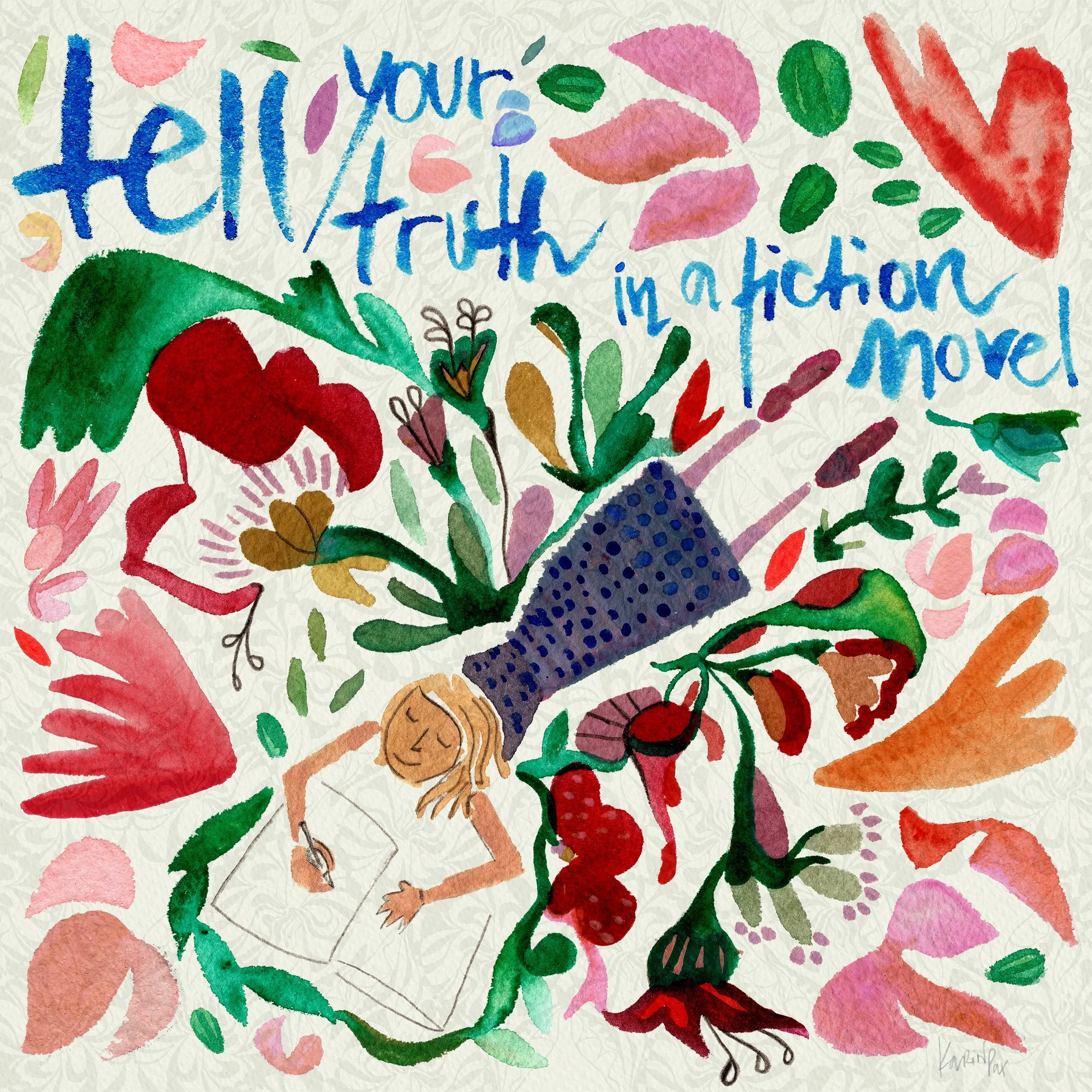
Her Novel by Karina Da Paixao Teixeira
Today I reflect on cognitive reframing, narrative therapy, and fictional autobiography as a therapeutic tool. Writing your story from a distance, especially in a fictional or third-person frame, is a well-researched pathway for trauma processing. The narrative distance helps the nervous system engage with complex and difficult material without being flooded by overwhelming somatic experiences. When you write, you are out of automatic mode. The automatic mode that Daniel Kahneman called, in his book Thinking Fast and Slow, "System 1" of the cognitive architecture of the brain. Creating a story, even one about your trauma, requires the activation of Kahneman's "System 2": the effortful and deliberate part of your brain that demands attention and mental energy.
I remember a patient I was seeing at a mental health unit who would shake non-stop, suffering from prolonged grief after losing his wife. The doctors were worried about cognitive deterioration. I introduced a few games with him, and since we started playing, the shaking stopped completely. I administered the Montreal Cognitive Assessment (MoCA) to collect evidence, and he did not make a single mistake. No signs of deterioration in cognitive function, orientation, language or memory. I repeated the same approach with war veterans. We played games of creating stories, and again and again, people emerged from their suffering and physical symptoms of trauma. I understood that relief comes when we engage the creative, meaning-making part of the brain.
What if you didn't have to tell it as fact?
The woman in this artwork, surrounded by colour and growth, is my attempt to show what I believe about how narrative therapy works. The invitation is to write your story from the inside. This illustration came to me while I was reading How to Write an Autobiographical Novel by Alexander Chee, a collection of essays about truth, memory, and the self that is brave enough to put itself on the page. It is not official research, but I have been learning that the story we carry doesn't need to be told as fact in order to begin the healing process. It is not about avoiding the truth, but finding a form that can hold the truth without collapsing under its weight.
Narrative therapy was developed by Michael White and David Epston, and it invites us to understand that we are not our problems. We are the authors of our own stories. Authors. Do you see the shift in perspective? It is about giving a different ending, or at least, a different relationship to the beginning. I believe that cognitive reframing works in a similar direction, because when we look at a painful memory or a difficult belief from a slight distance, when we step outside it even briefly, the nervous system gets a moment of relief. The memory, which has been living in the present tense, begins to find its place in the past. It becomes something that happened, rather than something that is always happening.
This is what I mean when I say: tell your truth in a fiction novel.
James Pennebaker spent decades studying expressive writing and what happens when people write about difficult experiences. What he found, consistently, across many studies, is that expressive writing reduces physiological stress, calms the nervous system, and over time, decreases the intrusive quality of painful memories. The body responds. Not because the writing fixes anything, but because giving form to what has been formless is itself a kind of relief. Peter Levine, who has written so beautifully about trauma and the body, describes how traumatic memory is often stored not as a clear narrative but as sensation, image, fragment. Bessel van der Kolk, whose work I return to often, reminds us that what we cannot yet say in words, we carry in the flesh.
And this is where poetry, fiction, image, where art enters as something more than metaphor. It enters as a genuine therapeutic tool. Because art doesn't need linearity. It doesn't need a beginning, middle and end. It can hold the fragment. It can be the fragment, and still make something whole.
Iris Brooke Gildea, a survivor, poet and therapist whose autoethnographic research on flashbacks and poetry I find deeply resonant, describes the act of writing through trauma not as constructing a cohesive narrative, but as becoming the author-witness of your own experience. That small shift, from being inside the storm to also watching it, naming it, giving it colour, is where something begins to change.
I recognise this from my own practice and lived experience. Not clinically. From the inside.
The fictional distance is not a lie
When I first encountered the idea of fictional autobiography as a therapeutic form, something settled in me. The idea that you can write toward your truth through a character who shares your history, your body, your fear, but has a different name, a different face, enough distance that the nervous system doesn't flood, felt like both a creative and a clinical insight at once.
Alexander Chee does this. Many of the writers I admire most do this. They tell the truth slant, as Emily Dickinson once said. And in that slant, they find something truer than a direct account might have reached. This is not avoidance. Avoidance keeps the story locked. This is an approach, careful, creative, at a pace the body can tolerate.
When we write in third person, or in fiction, or in metaphor, we create what researchers call narrative distance. And that distance is not a lie. It is a way of staying in the room with something difficult long enough to begin to understand it.
As I have shared from my own experience as a counsellor, somatic symptoms, the body's way of carrying what the mind hasn't yet processed, can begin to soften through this kind of writing. Not always. Not for everyone. Not as a replacement for therapy. But as a companion to it, or sometimes as a beginning.
What this looks like in practice
It doesn't need to be beautiful. That is the first thing I would say.
It doesn't need to be coherent or literary or finished. Brooke Gildea wrote her way through her own emergency stage in coffee shops and on floors, in fragments and verse that broke every grammatical rule, and that fragmentation was the point. The disjointed form mirrored the disjointed experience. The writing didn't clean it up. It witnessed it. And witnessing, it turns out, is enough to begin.
I know this because I have done it myself. I write, I paint, I rewrite. I find myself, as I said in my first reflection, enchanted by my own system. Not because the system is perfect, but because it is mine. It emerged from listening to what my body and my creativity needed, rather than from following a formula.
I encourage the same for you. Not my system. Yours.
What form wants to come? A letter to your younger self, written in the third person? A story where she has a different name but your hands? A poem that doesn't rhyme and doesn't make complete sense and says something true anyway? A painting of the feeling, before the words for it arrive?
There is no wrong way to begin.
An invitation
If something in this reflection has stirred something in you, a memory, an image, a sentence that wants to be written, I invite you to give it five minutes. Not to fix anything. Not to produce anything. Just to begin.
You could write: She was the kind of person who… and see what follows. You could give her your history and a different name and let her speak. You might be surprised by what she has been waiting to tell you.
The painting above is Her Novel. A woman, close to the ground, writing in a field of wild colour. That is the invitation. Not upright and productive. Close to the earth, close to herself.
Writing anyway.
With curiosity and deep respect for your story,
Karina
If you're curious…
Pennebaker, J. W. (1997). Opening Up: The Healing Power of Expressing Emotions. Guilford Press.
Kahneman, D. (2011). Thinking, Fast and Slow. Farrar, Straus and Giroux.
Levine, P. (1997). Waking the Tiger: Healing Trauma. North Atlantic Books.
van der Kolk, B. (2014). The Body Keeps the Score. Penguin.
White, M., & Epston, D. (1990). Narrative Means to Therapeutic Ends. Norton.
Brooke Gildea, I. J. (2020). The emergency stage: flashbacks and poetry: an autoethnographic approach. Journal of Poetry Therapy, 33(2), 110–122.
Chee, A. (2018). How to Write an Autobiographical Novel. Mariner Books.